

Blood Cancer Cure in India: What Modern Medicine Can Achieve Today
Blood Cancer Cure in India: What Modern Medicine Can Achieve Today
A clinically grounded guide to curability, survival rates, and the latest treatments available for leukemia, lymphoma, myeloma, and related blood cancers across India.
Few diagnoses carry as much fear as blood cancer. Yet the honest answer to the question patients across India ask every day — “Can blood cancer be cured?” — is increasingly hopeful. Over the past two decades, advances in targeted therapy, immunotherapy, and bone-marrow transplantation have transformed several blood cancers from near-certain death sentences into manageable, and in many cases curable, conditions.
This article explains what “cure” means in haematological oncology, which blood cancers are most amenable to cure, what the current survival data look like in India, and what treatment options are now available at specialist centres such as Apex Hospitals’ Haemato-Oncology department.
What Does “Cure” Actually Mean in Blood Cancer?
Oncologists typically use the term complete remission to describe the disappearance of all detectable cancer cells after treatment. “Cure” is a stronger claim — it implies that the disease will not return. In haematology, cure is generally inferred when a patient remains in complete remission for five or more years after treatment ends, with no evidence of minimal residual disease (MRD) on sensitive molecular tests.
Not all blood cancers behave the same way. Some, like certain subtypes of acute lymphoblastic leukaemia (ALL) in children, are genuinely curable in the majority of patients. Others, like multiple myeloma, are currently considered controllable rather than curable — but patients can live well for many years with modern maintenance therapy. Understanding this distinction helps patients and families set realistic, evidence-based expectations.
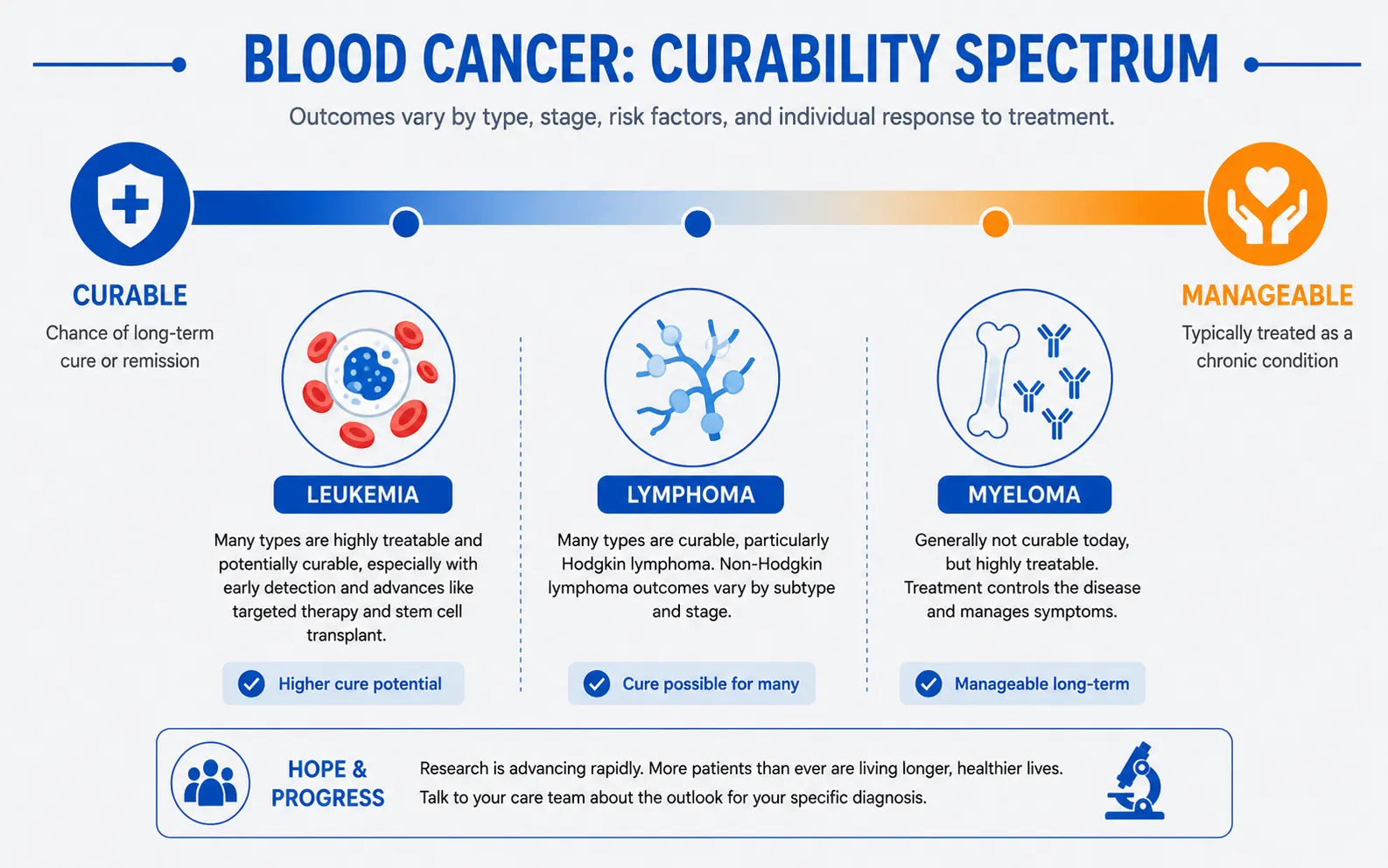
Types of Blood Cancer and Their Curability in India
1. Acute Lymphoblastic Leukaemia (ALL)
ALL is the most common childhood cancer in India. With contemporary multi-drug chemotherapy protocols, cure rates in children reach 80–90% at well-equipped centres. In adults, cure rates are lower (40–60%) but have improved significantly with the addition of targeted agents such as imatinib for Philadelphia-chromosome-positive ALL and blinatumomab for relapsed disease. Allogeneic bone-marrow transplantation remains the standard consolidation for high-risk adult ALL in first remission.
2. Acute Myeloid Leukaemia (AML)
AML is aggressive but potentially curable. Favourable-risk AML (e.g., core-binding-factor AML) achieves long-term remission in 60–70% of patients with intensive chemotherapy alone. Intermediate- and adverse-risk AML generally requires allogeneic transplant for best outcomes. New targeted drugs — FLT3 inhibitors (midostaurin, gilteritinib) and IDH1/2 inhibitors (enasidenib, ivosidenib) — are now available in India and have improved outcomes for molecularly defined subgroups.
3. Chronic Myeloid Leukaemia (CML)
CML is arguably the greatest success story in modern oncology. Tyrosine kinase inhibitors (TKIs) — imatinib, dasatinib, nilotinib — convert CML into a chronic condition that most patients manage with a daily tablet. A subset of patients who achieve deep molecular remission can safely discontinue TKI therapy and remain disease-free, a state called treatment-free remission (TFR). Generic imatinib is widely available in India, making this life-saving treatment accessible at relatively low cost.
4. Hodgkin Lymphoma
Hodgkin lymphoma is one of the most curable cancers in medicine. With ABVD or escalated BEACOPP chemotherapy, cure rates exceed 85% in early-stage disease and reach 70–80% even in advanced stages. Patients who relapse after first-line therapy can still be cured with high-dose chemotherapy followed by autologous stem-cell transplantation, and newer agents like brentuximab vedotin and pembrolizumab have further improved salvage outcomes.
5. Non-Hodgkin Lymphoma (NHL)
NHL is a heterogeneous group. Diffuse large B-cell lymphoma (DLBCL), the most common aggressive NHL, is cured in approximately 60–65% of patients with R-CHOP immunochemotherapy. Follicular lymphoma, the most common indolent NHL, is not currently curable with standard therapy but is highly controllable, with median survival exceeding 15–20 years. CAR-T cell therapy, now available at select Indian centres, has opened a curative pathway for relapsed/refractory DLBCL.
6. Multiple Myeloma
Multiple myeloma remains incurable with current standard therapy, but the treatment landscape has been transformed. Proteasome inhibitors (bortezomib, carfilzomib), immunomodulatory drugs (lenalidomide, pomalidomide), anti-CD38 monoclonal antibodies (daratumumab), and autologous stem-cell transplantation have extended median survival from 3–4 years to over 10 years in many patients. Quadruplet induction regimens and maintenance therapy are now standard of care at leading Indian centres.
7. Aplastic Anaemia
Severe aplastic anaemia, while not a cancer, is a life-threatening bone-marrow failure condition managed by haematologists. Allogeneic bone-marrow transplantation from a matched sibling donor is curative in over 80% of younger patients. For those without a matched donor, immunosuppressive therapy with anti-thymocyte globulin (ATG) and cyclosporine achieves durable responses in 60–70% of cases.
Blood Cancer Survival Rates in India: The Current Picture
Survival data from Indian cancer registries have historically lagged behind Western figures, largely due to late-stage diagnosis and limited access to specialist care. However, the gap is narrowing. Population-based cancer registry data published in the Indian Journal of Medical Research show improving five-year survival rates across haematological malignancies at tertiary centres, with ALL in children now approaching outcomes seen in high-income countries.
Key factors that influence survival in India include:
Stage at diagnosis: Early-stage lymphomas and CML diagnosed in chronic phase carry far better prognoses than advanced or blast-crisis presentations.
Molecular subtype: Genetic profiling (cytogenetics, FISH, next-generation sequencing) is essential to identify targetable mutations and risk-stratify treatment.
Access to transplant: Centres with active bone-marrow transplant programmes achieve significantly better outcomes for high-risk leukaemias and lymphomas.
Supportive care quality: Infection prevention, blood-product support, and nutritional care during chemotherapy directly affect treatment completion and survival.
The World Health Organization notes that access to accurate diagnosis and evidence-based treatment is the single most important determinant of cancer survival globally — a principle that underscores why choosing a specialist haematology centre matters profoundly.
Latest Treatments for Blood Cancer Available in India
India’s top haematology centres now offer most of the treatments available at leading international institutions. Here is a concise overview of the modalities shaping outcomes today:
Targeted Therapy
Small-molecule inhibitors that block specific molecular drivers of cancer growth — TKIs for CML and Philadelphia-positive ALL, FLT3 inhibitors for AML, BTK inhibitors (ibrutinib, acalabrutinib) for CLL and mantle-cell lymphoma, and venetoclax (BCL-2 inhibitor) for CLL and AML — are now available in India, many at significantly lower cost than in Western markets due to generic manufacturing.
Immunotherapy and Monoclonal Antibodies
Rituximab (anti-CD20) transformed the treatment of B-cell lymphomas and CLL. Daratumumab (anti-CD38) has become a backbone of myeloma therapy. Checkpoint inhibitors (pembrolizumab, nivolumab) are approved for relapsed Hodgkin lymphoma and some NHL subtypes. Bispecific antibodies such as blinatumomab are available for relapsed ALL.
CAR-T Cell Therapy
Chimeric antigen receptor T-cell (CAR-T) therapy represents the frontier of blood cancer treatment. Commercially approved CAR-T products are available at select Indian centres for relapsed/refractory DLBCL, ALL, and myeloma. India is also developing indigenous CAR-T platforms that promise to reduce costs substantially, potentially making this curative-intent therapy accessible to a far broader patient population.
Bone-Marrow and Stem-Cell Transplantation
Both autologous (using the patient’s own stem cells) and allogeneic (using a donor’s stem cells) transplantation are performed at specialist centres across India. Haploidentical transplantation — using a half-matched family donor — has expanded the donor pool significantly, making transplant accessible to patients without a fully matched sibling. Reduced-intensity conditioning regimens have extended transplant eligibility to older patients.
Next-Generation Sequencing and Precision Diagnostics
Accurate molecular diagnosis is the foundation of modern blood cancer care. NGS panels, flow cytometry for MRD assessment, FISH, and cytogenetics allow oncologists to classify disease precisely, choose the most effective targeted agent, and monitor treatment response at the molecular level. The Pathology and Diagnostics team at Apex Hospitals supports comprehensive haematological workups including renal biomarker panels and advanced laboratory diagnostics.
Warning Signs: When to See a Haematologist
Blood cancers often present with non-specific symptoms that are easy to attribute to fatigue or infection. Seek specialist evaluation promptly if you or a family member experiences:
Persistent, unexplained fatigue or weakness
Recurrent or severe infections
Unexplained weight loss (>10% body weight over 6 months)
Drenching night sweats
Painless swelling of lymph nodes in the neck, armpits, or groin
Easy bruising or prolonged bleeding from minor cuts
Bone pain, particularly in the back or ribs (suggestive of myeloma)
Abnormal blood counts on a routine complete blood count (CBC)
Early diagnosis remains the most powerful lever for improving outcomes. If you are concerned about any of these symptoms, the Internal Medicine specialists at Apex Hospitals can arrange an urgent haematological assessment.
The Role of Supportive Care in Blood Cancer Treatment
Curative-intent chemotherapy and transplantation place enormous physiological demands on the body. High-quality supportive care — infection prophylaxis, blood-product transfusion, nutritional support, and psychological care — is not optional; it is integral to treatment success.
Patients undergoing intensive blood cancer treatment may also develop complications affecting the kidneys, heart, or lungs. Apex Hospitals’ integrated model means that nephrology, cardiology, and pulmonary medicine specialists are available on-site to manage these complications without transferring the patient. The hospital’s Advanced ICU with ECMO capability and dedicated ICU and Critical Care unit provide a safety net for patients who develop life-threatening complications during treatment.
Nutritional rehabilitation is equally important. The Dietetics and Nutrition team at Apex Hospitals works alongside haematologists to optimise patients’ nutritional status before, during, and after chemotherapy, supporting treatment tolerance and recovery.
How Much Does Blood Cancer Treatment Cost in India?
Cost is a major concern for patients and families. India offers a significant cost advantage over Western countries for most blood cancer treatments, but costs still vary widely depending on the disease, treatment intensity, and centre.
Chemotherapy (per cycle): ₹15,000–₹80,000 depending on the regimen and whether branded or generic drugs are used.
Targeted therapy (monthly): Generic imatinib for CML can cost as little as ₹3,000–₹5,000/month; newer TKIs and monoclonal antibodies range from ₹50,000 to several lakhs per cycle.
Autologous stem-cell transplant: ₹8–₹15 lakh at most Indian centres.
Allogeneic bone-marrow transplant: ₹15–₹30 lakh depending on donor type and conditioning regimen.
CAR-T cell therapy: Currently ₹30–₹40 lakh for commercial products; indigenous platforms aim to reduce this significantly.
Apex Hospitals is empanelled under Ayushman Bharat and major insurance and TPA schemes, which can substantially reduce out-of-pocket costs for eligible patients. The hospital’s billing team can assist with pre-authorisation and claims support.
What Sets a High-Quality Blood Cancer Centre Apart?
When evaluating hospitals for blood cancer treatment, patients should look for:
Dedicated haemato-oncology unit with specialist haematologists, not just general oncologists.
Multidisciplinary tumour board that reviews complex cases with input from haematology, radiology, pathology, and transplant specialists.
In-house molecular diagnostics for cytogenetics, FISH, and NGS — avoiding delays caused by outsourcing critical tests.
Chemotherapy day-care units that allow outpatient administration of most regimens, reducing hospitalisation burden.
Bone-marrow transplant programme or a clear referral pathway to a transplant centre for eligible patients.
NABH accreditation, which signals adherence to national quality and safety standards.
Apex Hospitals, a NABH-accredited multi-specialty group established in 1994, meets all of these criteria. The hospital’s chemotherapy day-care units, on-site CT, MRI, and emergency laboratory services, and 70+ specialist doctors across 30+ sub-specialties create an environment where blood cancer patients receive integrated, protocol-driven care. The HOPE Tele-ICU Command Centre — featured in the Harvard Business Review — also extends specialist oversight to patients in remote areas of Rajasthan, reducing the need for long-distance travel during treatment.
For a comprehensive overview of the oncology services available, visit the Oncology department at Apex Hospitals.
Frequently Asked Questions
Can blood cancer be completely cured in India?
Yes, for several types. Childhood ALL, Hodgkin lymphoma, and favourable-risk AML are curable in the majority of patients at well-equipped Indian centres. CML is effectively controlled long-term with TKIs, and a subset of patients achieve treatment-free remission. Multiple myeloma and follicular lymphoma are not currently curable with standard therapy but are highly manageable, with patients living for many years with good quality of life.
What is the survival rate for blood cancer in India?
Survival rates vary by cancer type, stage, and centre. Childhood ALL at specialist centres achieves 80–90% five-year survival. Hodgkin lymphoma exceeds 85% in early stages. CML patients on TKIs have near-normal life expectancy. AML five-year survival ranges from 30–70% depending on molecular risk. Outcomes at NABH-accredited tertiary centres in India are increasingly comparable to international benchmarks.
Which hospital in India has the best blood cancer treatment?
The best outcomes are achieved at NABH-accredited hospitals with dedicated haemato-oncology units, in-house molecular diagnostics, chemotherapy day-care facilities, and access to bone-marrow transplantation. Apex Hospitals, with its specialist Haemato-Oncology department, integrated critical care, and Ayushman Bharat empanelment, is one of Rajasthan’s leading centres for blood cancer care.
What are the latest treatments for blood cancer available in India?
India now offers targeted therapies (TKIs, BTK inhibitors, BCL-2 inhibitors), monoclonal antibodies (rituximab, daratumumab), checkpoint immunotherapy (pembrolizumab, nivolumab), bispecific antibodies (blinatumomab), CAR-T cell therapy at select centres, and both autologous and allogeneic stem-cell transplantation. Next-generation sequencing for molecular profiling is also widely available at specialist centres.
How much does blood cancer treatment cost in India?
Costs range from ₹15,000 per chemotherapy cycle for standard regimens to ₹30–₹40 lakh for CAR-T cell therapy. Autologous transplant typically costs ₹8–₹15 lakh and allogeneic transplant ₹15–₹30 lakh. Ayushman Bharat and private insurance can significantly reduce out-of-pocket expenses for eligible patients.
References
Concerned About Blood Cancer Symptoms?
Our specialist haematology team at Apex Hospitals is here to guide you from diagnosis through to recovery — with evidence-based protocols, integrated critical care, and compassionate support at every step.