
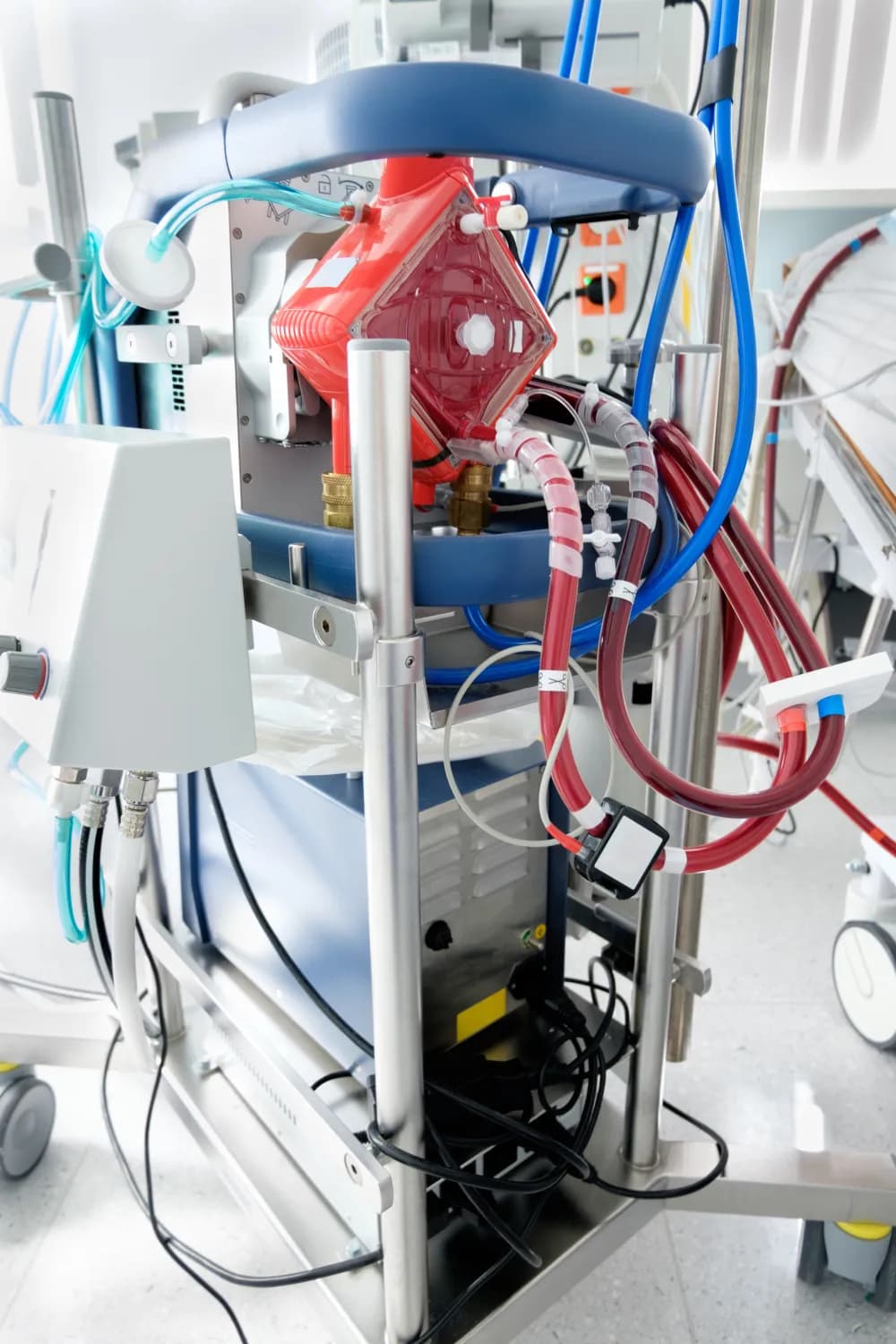
When mechanical ventilation reaches its limits, Extracorporeal Membrane Oxygenation (ECMO) can take over the work of the lungs — buying critical time for recovery. Here is what patients and families in Jaipur need to know.
By the Clinical Team at Apex Hospitals · Published July 2025
A mechanical ventilator is often the first line of support when a patient cannot breathe adequately on their own. It pushes oxygen-enriched air into the lungs and removes carbon dioxide. For millions of critically ill patients every year, it is life-saving. But there is a ceiling to what a ventilator can do.
In conditions such as severe Acute Respiratory Distress Syndrome (ARDS), refractory pneumonia, or massive pulmonary embolism, the lungs can become so damaged or inflamed that even the highest ventilator settings cannot transfer enough oxygen into the bloodstream. Clinicians call this refractory hypoxaemia — a state where oxygen saturation remains dangerously low despite maximum ventilatory support.
At this point, continuing to push harder through the ventilator can itself cause harm — a phenomenon known as ventilator-induced lung injury (VILI). The lungs need rest, not more pressure. This is precisely the clinical scenario where Extracorporeal Membrane Oxygenation (ECMO) becomes the next — and sometimes only — viable option.
A ventilator works with the lungs — it assists breathing by delivering pressurised oxygen through the airways. ECMO, by contrast, works around the lungs. It is an external circuit that draws blood out of the body, passes it through an artificial membrane oxygenator (which adds oxygen and removes carbon dioxide), and returns the oxygenated blood to the body — all without the blood ever needing to pass through the damaged lungs.
Think of it as a temporary artificial lung running outside the body. The key difference is this: a ventilator supports gas exchange through the patient's own lung tissue; ECMO replaces that gas exchange entirely when the lung tissue is too injured to function.
| Feature | Ventilator | ECMO |
|---|---|---|
| Where gas exchange occurs | Inside the patient's lungs | In an external membrane oxygenator |
| Lung involvement | Lungs must participate | Lungs can rest completely |
| Suitable for | Moderate respiratory failure | Severe / refractory respiratory or cardiac failure |
| Risk of lung injury | Possible at high settings (VILI) | Reduced — allows ultra-protective ventilation |
| Complexity | Moderate | High — requires specialised ECMO team |
There are two main configurations of ECMO, and the choice depends on whether the problem is primarily in the lungs, the heart, or both.
In VV-ECMO, blood is drawn from a large vein (typically the femoral or jugular vein), oxygenated externally, and returned to another large vein. The heart continues to pump this oxygenated blood around the body. VV-ECMO is the preferred mode when the heart is functioning adequately but the lungs have failed — the classic scenario in severe ARDS or refractory pneumonia.
VA-ECMO supports both the heart and lungs simultaneously. Blood is drawn from a vein and returned to an artery, effectively bypassing both organs. This is used in cardiogenic shock, cardiac arrest, or when a patient's heart cannot maintain adequate circulation even after the lungs are supported.
The ICU and critical care team at Apex Hospitals, Jaipur operates both VV and VA ECMO machines, enabling the right configuration to be deployed rapidly based on each patient's haemodynamic profile.
Clinicians typically consider ECMO when a patient on maximum ventilator support still meets one or more of the following criteria — broadly aligned with international critical care guidelines:
PaO₂/FiO₂ ratio below 80 mmHg despite high PEEP and FiO₂ of 100% for more than 6 hours
Uncompensated hypercapnia (rising CO₂) with pH below 7.25 despite optimised ventilator settings
High plateau pressures (above 30 cmH₂O) indicating risk of further barotrauma
Refractory hypoxaemia not responding to prone positioning, inhaled nitric oxide, or recruitment manoeuvres
Reversible underlying cause — ECMO is a bridge, not a cure; the underlying condition must have a realistic chance of recovery or a definitive treatment (such as lung transplant)
Timing matters enormously. Research published on PubMed consistently shows that earlier initiation of ECMO — before prolonged high-pressure ventilation causes irreversible lung damage — is associated with better outcomes. Waiting too long can reduce the benefit significantly.
A common misconception is that ECMO replaces the ventilator entirely. In most cases, the ventilator remains in place but is dialled down dramatically — a strategy called ultra-protective lung ventilation. With ECMO handling the bulk of gas exchange, the ventilator can be set to very low tidal volumes and pressures, allowing the injured lung tissue to rest, reduce inflammation, and begin healing.
This combination — ECMO doing the heavy lifting while the ventilator provides minimal background support — is what gives the lungs the best chance of recovery. In some patients, particularly those on VV-ECMO for ARDS, clinicians may even attempt to extubate (remove the breathing tube) while ECMO continues, allowing the patient to breathe spontaneously. This approach, sometimes called awake ECMO, can improve rehabilitation outcomes and reduce sedation-related complications.
While ECMO can be used in a range of critical conditions, the following are the most frequent clinical scenarios where ventilator support proves insufficient and ECMO becomes necessary:
ARDS causes widespread inflammation and fluid accumulation in the air sacs of the lungs, severely impairing oxygen transfer. According to the World Health Organization, severe respiratory infections — a leading trigger of ARDS — remain a major cause of critical illness globally. In the most severe cases of ARDS, VV-ECMO has been shown to improve survival when initiated early at experienced centres.
Pneumonia caused by influenza, COVID-19, or other pathogens can progress to respiratory failure that overwhelms ventilator capacity. ECMO gained significant attention during the COVID-19 pandemic as a rescue therapy for patients with refractory hypoxaemia.
A large blood clot blocking the pulmonary arteries can cause acute right heart failure and severe hypoxaemia simultaneously. VA-ECMO can stabilise the patient while definitive treatment (thrombolysis or surgical embolectomy) is arranged.
Some patients develop severe lung dysfunction after open-heart surgery. ECMO can bridge them through the recovery period. Apex Hospitals' cardiothoracic surgery team works closely with the ECMO unit for such post-operative cases.
In patients with end-stage lung disease awaiting transplant, ECMO can serve as a bridge — keeping the patient alive and stable until a suitable donor organ becomes available.
Understanding the ECMO process can reduce anxiety for families facing this decision under pressure.
Large tubes (cannulas) are inserted into major blood vessels — usually under sedation in the ICU. This is a bedside procedure performed by a trained ECMO specialist and does not require an operating theatre in most cases.
Once the circuit is running, a dedicated ECMO specialist monitors the machine continuously — 24 hours a day. Blood flow rates, oxygen delivery, and anticoagulation (blood-thinning to prevent clots in the circuit) are adjusted in real time. The advanced ICU at Apex Hospitals is equipped with both VV and VA ECMO machines, supported by a multidisciplinary team including intensivists, perfusionists, and specialist nurses.
With ECMO managing oxygenation, the ventilator is reduced to minimal settings. The clinical team monitors lung recovery through daily chest imaging, blood gas analysis, and lung compliance measurements. Recovery timelines vary — some patients come off ECMO within days; others may require support for several weeks.
When the lungs show sufficient recovery, ECMO support is gradually reduced (weaned) while monitoring whether the patient can maintain adequate oxygenation independently. Once confirmed, the cannulas are removed — a process called decannulation.
Recovery from severe lung failure and prolonged ICU stay requires structured rehabilitation. Apex Hospitals' physiotherapy and rehabilitation team works with post-ECMO patients to rebuild strength, respiratory endurance, and functional independence.
ECMO is not without risk, and families deserve a clear-eyed understanding of what it involves. Common complications include bleeding (due to anticoagulation), clot formation in the circuit, infection, and limb ischaemia at the cannulation site. These risks are managed by experienced teams but cannot be eliminated entirely.
Outcomes depend heavily on the underlying diagnosis, the patient's age and pre-existing health, and how early ECMO was initiated. At Apex Hospitals, the ECMO programme has achieved an 80% survival rate in ECMO cases — one of the strongest outcomes reported in Rajasthan. This figure reflects both patient selection and the quality of ongoing management by the critical care team.
It is equally important to acknowledge that ECMO is not appropriate for every patient. When the underlying condition is irreversible and no bridge therapy exists, the clinical team will have an honest conversation with the family about goals of care. This is a sign of ethical, patient-centred medicine — not a failure of technology.
Access to ECMO in Rajasthan has historically been limited to a handful of tertiary centres. Apex Hospitals, Malviya Nagar, Jaipur has built one of the most capable ECMO programmes in the region, with the following distinguishing features:
Both VV and VA ECMO machines available in-house, enabling rapid deployment for lung and cardiac failure scenarios.
80% ECMO survival rate — among the strongest outcomes in Rajasthan, reflecting experienced patient selection and management.
HOPE Tele-ICU Command Centre — a 24×7 remote monitoring platform connecting 18 partner sites across Rajasthan, recognised in Harvard Business Review and honoured at the GovConnect Conclave for HealthTech Excellence. This means specialist ECMO oversight is available even for patients being stabilised at partner facilities before transfer.
NABH-accredited facility with on-site CT, MRI, emergency labs, and a dedicated Cardiac ICU — all essential for managing the complex comorbidities of ECMO patients.
Multidisciplinary team including intensivists, pulmonologists, cardiothoracic surgeons, and rehabilitation specialists — all under one roof. Explore the full range of pulmonary medicine specialists and cardiology expertise that supports ECMO care at Apex.
Empanelled under Ayushman Bharat and major insurance/TPA schemes, reducing financial barriers for eligible patients.
Yes — and this is actually the standard approach. Once ECMO is initiated, the ventilator is not removed but is set to very low, lung-protective settings. ECMO handles the majority of gas exchange while the ventilator provides minimal background support, allowing the lungs to rest and heal.
Duration varies widely. Some patients are weaned off ECMO within 5–7 days as their lungs recover. Others may require support for several weeks. In bridge-to-transplant scenarios, ECMO can be maintained for months at experienced centres with appropriate monitoring.
The cannulation procedure is performed under sedation or anaesthesia, so the patient does not feel pain during insertion. Once on ECMO, patients are typically sedated, though the degree of sedation is adjusted based on clinical goals — some patients on awake ECMO protocols are conscious and can communicate.
Survival rates depend on the underlying condition, patient age, and how early ECMO was started. At Apex Hospitals, the programme has achieved an 80% survival rate in ECMO cases. Nationally and internationally, survival rates for VV-ECMO in ARDS range from 50–70% at experienced centres, making centre experience a critical factor in outcomes.
Yes. Apex Hospitals, Malviya Nagar, Jaipur operates a fully equipped ECMO programme with both VV and VA machines, a dedicated ECMO team, and 24×7 critical care support. Patients from across Rajasthan are referred here for ECMO when local facilities cannot provide this level of care.
Apex Hospitals is empanelled under Ayushman Bharat and accepts most major insurance and TPA schemes. Coverage for ECMO varies by policy — the hospital's billing and insurance team can help families understand their entitlements before treatment begins.
If a family member is on a ventilator and not improving, or if you have been told that ECMO may be needed, speaking with a specialist early can make a meaningful difference. The ECMO programme at Apex Hospitals, Jaipur is available for consultations, second opinions, and emergency transfers. You can also explore our broader multispecialty care at Apex Hospitals or reach our team at 098290 30011.
Our ECMO and ICU specialists at Apex Hospitals, Jaipur are available to answer your questions and guide you through every step of critical care decision-making.

Download Our App


Powered By Docfyn



