
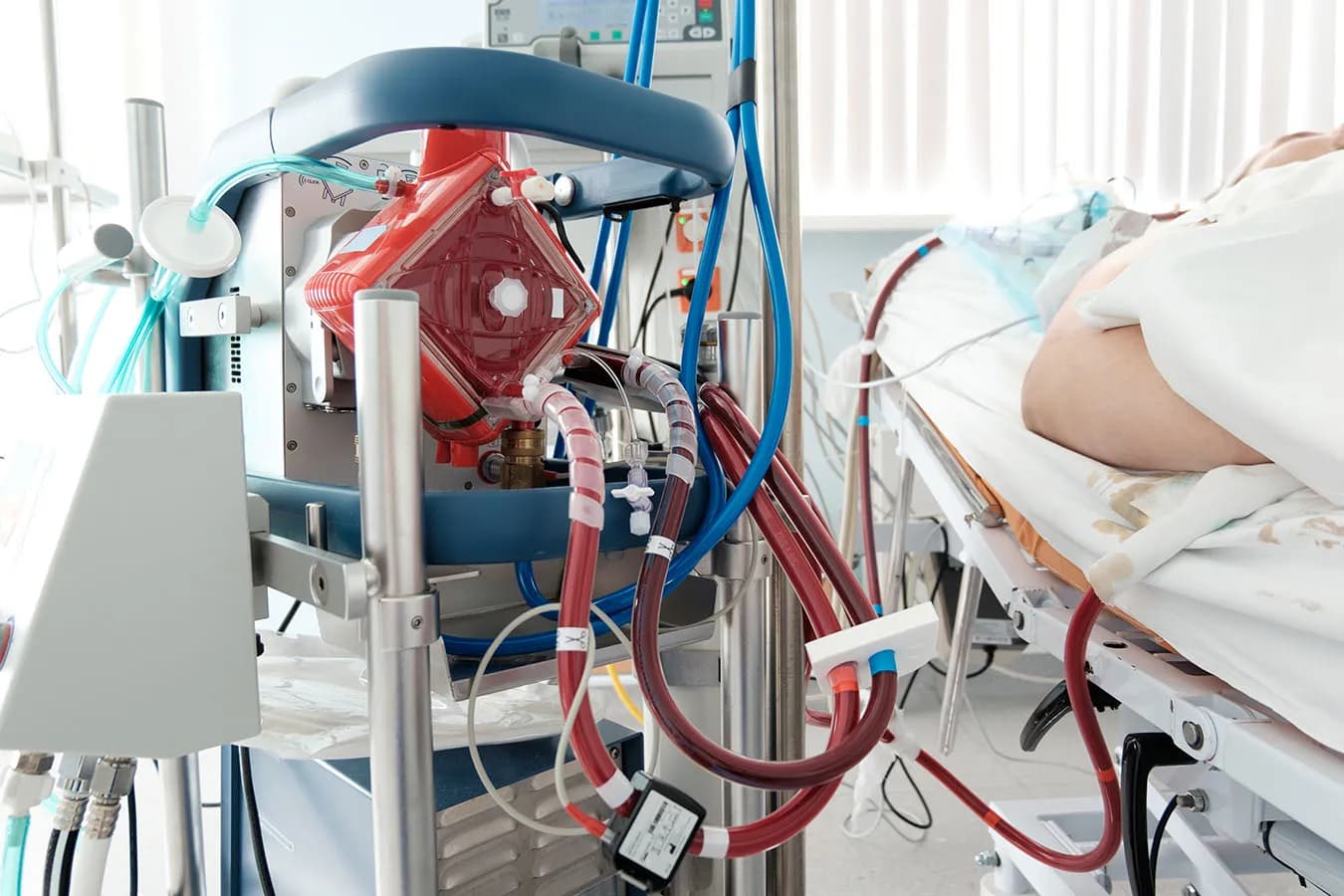
When the heart is too weak to pump on its own, Extracorporeal Membrane Oxygenation (ECMO) steps in as a life-sustaining bridge — buying critical time for recovery, transplant, or a long-term device.
By Apex Hospitals 11th July, 2026
Extracorporeal Membrane Oxygenation — universally abbreviated as ECMO — is an advanced life-support technology that temporarily takes over the work of the heart, the lungs, or both when these organs can no longer sustain adequate circulation. The word extracorporeal simply means "outside the body": blood is drawn out, passed through a membrane oxygenator that adds oxygen and removes carbon dioxide, and then returned to the patient's circulation — all within seconds.
ECMO is not a cure. It is a bridge — a powerful, precisely managed bridge that keeps a critically ill patient alive while the underlying cause of heart or lung failure is treated, or while a more definitive solution (such as a heart transplant or a ventricular assist device) is arranged. According to the Extracorporeal Life Support Organization (ELSO), more than 150,000 ECMO runs have been recorded globally, with survival rates improving steadily as technology and clinical protocols advance.
At Apex Hospitals' ECMO programme in Jaipur, the team has achieved an 80% survival rate in ECMO cases — one of the strongest outcomes reported in Rajasthan — using both Veno-Venous (VV-ECMO) and Veno-Arterial (VA-ECMO) configurations.
Many patients and families confuse ECMO with the cardiopulmonary bypass (CPB) machine used during open-heart surgery. While both devices oxygenate blood outside the body, they serve very different purposes:
| Feature | Heart-Lung Machine (CPB) | ECMO |
|---|---|---|
| Duration of use | Hours (during surgery only) | Days to weeks |
| Setting | Operating theatre | ICU, emergency, or bedside |
| Heart stopped? | Yes (cardioplegia used) | No — heart continues to beat |
| Primary goal | Surgical field access | Sustained organ perfusion |
| Mobility | Fixed to OR table | Portable; patient can be moved |
In short, ECMO is designed for prolonged cardiac or respiratory support in a living, beating-heart patient — a capability the conventional heart-lung machine was never built to provide.
Understanding the mechanics of ECMO helps patients and families make sense of what can look like an intimidating tangle of tubes and machines at the bedside. Here is the circuit in plain language:
Cannulation: A trained intensivist or cardiac surgeon inserts large-bore cannulas (tubes) into major blood vessels — typically the femoral vein and artery in the groin, or the jugular vein in the neck, depending on the ECMO type.
Blood drainage: A centrifugal pump draws oxygen-depleted blood out of the venous circulation and into the ECMO circuit.
Oxygenation and CO₂ removal: Blood passes through the membrane oxygenator — a hollow-fibre device that mimics the gas-exchange function of the lungs. Oxygen diffuses in; carbon dioxide diffuses out.
Temperature regulation: A heat exchanger within the circuit warms or cools the blood to maintain the patient's target body temperature.
Return to circulation: Freshly oxygenated blood is pumped back into the patient's arterial system (VA-ECMO) or venous system (VV-ECMO), restoring adequate oxygen delivery to vital organs.
Continuous monitoring: Bedside nurses and intensivists monitor flow rates, pressures, oxygen saturation, and anticoagulation parameters around the clock.
The entire circuit is primed with saline or blood products before connection, and anticoagulant medication (usually heparin) is given continuously to prevent clotting within the tubing.
When the primary problem is cardiac failure — the heart cannot pump enough blood to sustain circulation — clinicians use Veno-Arterial ECMO (VA-ECMO). This is the configuration most relevant to the question of how ECMO supports heart function.
In VA-ECMO, blood is drained from the venous side (typically the right atrium or femoral vein) and returned to the arterial side (typically the femoral artery or aorta). This effectively bypasses both the right and left ventricles, allowing the heart to rest while the ECMO pump maintains systemic blood pressure and organ perfusion.
Cardiogenic shock (heart attack with pump failure)
Acute myocarditis (viral or autoimmune inflammation of the heart muscle)
Post-cardiotomy syndrome (heart failure after open-heart surgery)
Massive pulmonary embolism with right heart failure
Refractory ventricular arrhythmias
Bridge to heart transplant or ventricular assist device (VAD)
Cardiac arrest unresponsive to conventional CPR (ECPR)
A 2020 review published in Circulation (American Heart Association) highlighted that VA-ECMO can restore mean arterial pressure and cardiac output within minutes of initiation in patients with refractory cardiogenic shock — a condition that carries a mortality rate exceeding 50% without mechanical circulatory support.
The ICU and Critical Care team at Apex Hospitals manages VA-ECMO patients in a dedicated Cardiac ICU equipped with continuous haemodynamic monitoring, ensuring that flow rates are titrated to the patient's evolving cardiac recovery.
When the heart is functioning adequately but the lungs are failing — as in severe ARDS (Acute Respiratory Distress Syndrome) or COVID-19-related respiratory failure — Veno-Venous ECMO (VV-ECMO) is used. Blood is drained from and returned to the venous circulation, bypassing the lungs entirely for gas exchange while the heart continues to pump normally.
VV-ECMO does not provide direct cardiac support, but by dramatically improving oxygenation, it relieves the secondary strain that hypoxia places on the right ventricle — indirectly protecting heart function in patients with combined cardiopulmonary compromise.
The Department of Pulmonary Medicine at Apex Hospitals works closely with the critical care team to determine the appropriate ECMO modality and to manage weaning from respiratory support.
ECMO is almost always a temporary measure. Clinicians plan for one of three outcomes from the moment ECMO is initiated:
In conditions such as acute myocarditis or post-cardiac-surgery shock, the underlying heart muscle may recover fully if given enough time to rest. ECMO provides that rest — sometimes for days, sometimes for weeks — while the heart heals. Once cardiac function improves sufficiently, ECMO is gradually weaned and the cannulas removed.
When the prognosis is uncertain, ECMO stabilises the patient while the clinical team gathers more information — imaging, biopsy results, specialist consultations — to determine whether recovery is likely or whether a more permanent solution is needed.
For patients with end-stage heart failure who are candidates for a heart transplant or a long-term ventricular assist device, ECMO keeps them alive and haemodynamically stable while they await a donor organ or surgical planning. The Cardiothoracic Surgery team at Apex Hospitals collaborates closely with the ECMO intensivists to manage this transition.
Patients on ECMO are almost always in the ICU and are typically sedated, at least initially, to reduce oxygen demand and allow the heart and lungs to rest. As their condition stabilises, sedation may be lightened — and in some centres, patients on VV-ECMO can even be awake and breathing spontaneously, a strategy called "awake ECMO" that is associated with better rehabilitation outcomes.
Family members often find the ECMO circuit alarming at first glance. The machine is roughly the size of a large suitcase on wheels; dark red blood is visible moving through the tubing; alarms sound periodically as the system self-monitors. The bedside nurse and ECMO specialist are present continuously to manage these parameters.
At Apex Hospitals, the Advanced ICU with ECMO capability is staffed around the clock by trained intensivists and ECMO-certified nurses. The HOPE Tele-ICU Command Centre — featured in Harvard Business Review — provides an additional layer of remote expert oversight, connecting the bedside team with senior specialists even in the middle of the night.
ECMO is a high-risk intervention reserved for patients who would otherwise not survive. Potential complications include:
Bleeding: Continuous anticoagulation increases the risk of haemorrhage, including intracranial bleeding.
Thrombosis: Clots can form in the circuit or in the patient's vessels despite anticoagulation.
Limb ischaemia: Femoral arterial cannulation can reduce blood flow to the leg; a distal perfusion cannula is routinely inserted to mitigate this.
Infection: Prolonged cannulation creates a risk of bloodstream infection.
Haemolysis: The mechanical pump can damage red blood cells over time.
Neurological injury: Emboli or haemodynamic instability can affect the brain.
These risks are carefully weighed against the near-certain mortality of untreated cardiogenic shock or respiratory failure. A multidisciplinary team — including cardiologists, cardiac surgeons, intensivists, and haematologists — reviews each patient's candidacy before ECMO is initiated.
The Cardiology specialists at Apex Hospitals work alongside the critical care team to ensure that every ECMO decision is evidence-based and patient-centred.
Weaning from ECMO is a gradual, carefully monitored process. The clinical team progressively reduces the ECMO flow rate — typically in small decrements over hours to days — while closely observing haemodynamic parameters: blood pressure, cardiac output, mixed venous oxygen saturation, and echocardiographic indices of ventricular function.
A bedside echocardiogram is the most important tool during weaning. It allows the intensivist to watch the heart's contractility in real time as ECMO support is reduced. If the ventricles maintain adequate function at low ECMO flows, decannulation (removal of the cannulas) is planned — usually performed at the bedside under local anaesthesia.
After ECMO, patients typically require a period of intensive rehabilitation. The Physiotherapy and Rehabilitation team at Apex Hospitals begins early mobilisation as soon as the patient is haemodynamically stable, helping to rebuild muscle strength and cardiovascular endurance lost during the critical illness.
Access to ECMO has historically been limited to large metropolitan centres. Apex Hospitals has changed that equation for patients across Rajasthan. The hospital's ECMO programme, based at the Malviya Nagar campus in Jaipur, offers:
Both VV-ECMO and VA-ECMO configurations, managed by a dedicated ECMO team.
An 80% survival rate in ECMO cases — among the best outcomes in Rajasthan.
A Cardiac ICU and Advanced ICU with 24×7 intensivist coverage.
The HOPE Tele-ICU Command Centre, connecting 18 partner sites across the state for remote expert consultation — reducing the need for high-risk inter-hospital transfers.
NABH accreditation, ensuring adherence to national quality and safety standards.
Empanelment under Ayushman Bharat and major insurance/TPA schemes, making ECMO accessible to a broader population.
If a family member is facing a cardiac emergency and ECMO may be required, the Emergency and Trauma team at Apex Hospitals Jaipur is available around the clock. Early referral to an ECMO-capable centre significantly improves outcomes in cardiogenic shock.
No. A ventilator supports breathing by delivering air and oxygen into the lungs through a tube in the airway. ECMO bypasses the lungs (and/or the heart) entirely by oxygenating blood outside the body. Many ECMO patients are also on a ventilator, but the two devices serve different functions.
Most ECMO runs last between a few days and four weeks. Prolonged ECMO beyond 30 days is possible but carries increasing complication risks. The goal is always to wean the patient off ECMO as soon as the heart or lungs have recovered sufficiently.
ECMO does not cure the underlying cause of heart failure. It provides temporary mechanical support that keeps the patient alive while the heart recovers or while a definitive treatment — such as a transplant or a ventricular assist device — is arranged. In cases of reversible causes like myocarditis, the heart can recover fully after ECMO support.
Patients are usually sedated during ECMO initiation and the early phase of support. As they stabilise, sedation is reduced. The cannula insertion sites may cause discomfort, which is managed with appropriate analgesia. The ECMO circuit itself does not cause pain.
The decision is made by a multidisciplinary team including intensivists, cardiologists, and cardiac surgeons. Strict criteria — including the severity of cardiac or respiratory failure, the reversibility of the underlying condition, and the patient's overall prognosis — are evaluated before ECMO is initiated.
Yes. Apex Hospitals in Malviya Nagar, Jaipur, operates a fully equipped ECMO programme with both VV and VA configurations, 24×7 intensivist coverage, and an 80% survival rate in treated cases — making it one of the most experienced ECMO centres in Rajasthan.
The ECMO and Critical Care specialists at Apex Hospitals Jaipur are available 24×7 — reach out for a consultation or emergency referral.

Download Our App


Powered By Docfyn