
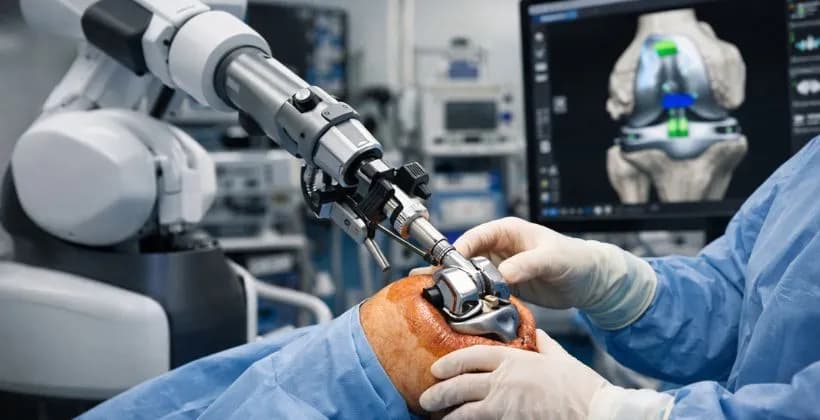
How AI-assisted robotic technology is making knee replacement safer, more precise, and genuinely less painful — and what patients in Jaipur need to know before choosing surgery.
By the Clinical Editorial Team at Apex Hospitals · Published June 2026
Knee osteoarthritis affects millions of Indians, and Rajasthan is no exception. Sedentary lifestyles, rising rates of obesity, and an ageing population have pushed knee joint disease to the forefront of orthopaedic consultations across Jaipur. According to the World Health Organization, musculoskeletal conditions — including knee osteoarthritis — are the leading cause of disability worldwide, affecting roughly 1 in 3 adults over the age of 45.
For many patients, the journey begins with stiffness in the morning, progresses to pain while climbing stairs, and eventually reaches a point where even walking short distances becomes difficult. When physiotherapy, medications, and injections no longer provide adequate relief, knee replacement surgery becomes the most effective long-term solution.
But the word "surgery" still carries fear for many. That fear is now being addressed head-on by a new generation of robotic-assisted knee replacement — a technology that is changing outcomes dramatically at centres like Apex Hospitals' Orthopaedic Robotic Surgery programme in Jaipur.
Robotic knee replacement is not a procedure performed by a robot independently. The surgeon remains fully in control at all times. What the robotic system provides is a layer of real-time, data-driven precision that the human hand alone cannot consistently achieve.
In a conventional knee replacement, the surgeon uses manual instruments and pre-operative X-rays to plan and execute bone cuts. In robotic-assisted surgery, the system maps the patient's unique knee anatomy intraoperatively and provides continuous feedback to guide every cut within a pre-planned safe zone. The result: implants that fit more accurately, joints that are better balanced, and patients who recover faster.
At Apex Hospitals Malviya Nagar, the team uses the CORI Surgical System by Smith+Nephew — an imageless, handheld robotic platform that uses RI.KNEE real-time intraoperative 3D mapping and AI-assisted implant planning. Crucially, it requires no pre-operative CT or MRI scan, reducing both cost and radiation exposure for the patient.
Understanding the process can significantly reduce pre-operative anxiety. Here is what a patient at Apex Hospitals can expect:
Pre-surgical consultation: The orthopaedic surgeon assesses your knee using clinical examination and standard X-rays. No CT or MRI is required for the CORI system.
Intraoperative mapping: Once in the operating theatre, the CORI system creates a real-time 3D map of your specific knee anatomy. This happens during the surgery itself, not before.
AI-assisted implant planning: The system calculates the optimal implant size, position, and alignment based on your unique anatomy — personalised to the millimetre.
Guided bone resection: The surgeon uses the handheld robotic tool to make precise bone cuts. The system is 29% faster in bone resection and responds 5× faster than earlier robotic platforms, with 2× more cutting volume.
Implant placement and closure: The implant is fixed in the planned position. The surgeon verifies alignment and closes the wound. Most patients are mobilised within 24 hours.
Patient testimonial: "अब चलना आसान हो गया" — A knee replacement patient shares their recovery experience after treatment by Dr. Ashish Rana, Orthopaedic & Joint Replacement Expert at Apex Hospitals, Jaipur.
The phrase "painless knee surgery" is used widely in patient conversations, and it deserves an honest explanation. No major surgery is entirely without discomfort during recovery. However, robotic-assisted knee replacement is associated with significantly less post-operative pain compared to conventional techniques — for several well-documented reasons:
Smaller, more precise bone cuts mean less trauma to surrounding soft tissue.
Better implant alignment reduces abnormal stress on the joint, which is a major source of post-operative pain.
Reduced blood loss during surgery correlates with faster healing and less inflammation.
Multimodal pain management protocols at Apex Hospitals — combining nerve blocks, anti-inflammatory agents, and early physiotherapy — further minimise discomfort in the days following surgery.
A growing body of peer-reviewed literature on PubMed supports the finding that robotic-assisted total knee arthroplasty results in improved early functional outcomes and patient satisfaction scores compared to manual techniques. Most Apex Hospitals patients are walking with support within 24 hours of surgery and are discharged within 3–4 days.
Patients often ask whether the additional technology is worth it. Here is a straightforward comparison:
| Factor | Conventional Surgery | Robotic-Assisted (CORI) |
|---|---|---|
| Pre-op imaging required | X-ray + sometimes CT | X-ray only (no CT/MRI) |
| Implant alignment accuracy | Surgeon-dependent | AI-guided, real-time 3D |
| Soft tissue trauma | Higher | Minimised |
| Recovery to walking | 2–3 days typically | Often within 24 hours |
| Surgeon control | Full manual | Full — robot assists, surgeon decides |
| Patient satisfaction | Good | Consistently higher in studies |
Robotic-assisted knee replacement is suitable for most patients who are candidates for conventional total or partial knee replacement. Ideal candidates typically include:
Adults with moderate to severe knee osteoarthritis confirmed on X-ray
Patients whose pain significantly limits daily activities despite non-surgical treatment
Those with knee deformity (varus or valgus alignment) that affects gait
Patients who want a faster, more predictable recovery
Individuals with rheumatoid arthritis causing joint destruction
The orthopaedics team at Apex Hospitals conducts a thorough pre-operative assessment — including cardiovascular fitness, bone density, and BMI — to ensure each patient is optimally prepared for surgery and anaesthesia. Patients with uncontrolled diabetes, severe cardiac disease, or active infection may need medical optimisation before proceeding.
If you have concerns about your heart health ahead of surgery, our cardiology specialists in Jaipur work closely with the orthopaedic team to clear patients safely for the operating theatre.
Recovery from robotic knee replacement follows a structured timeline. While individual progress varies, here is a general roadmap based on clinical protocols at Apex Hospitals:
Day 1–2: Physiotherapy begins. Most patients stand and take a few steps with a walker on the day after surgery.
Day 3–4: Discharge home or to a step-down facility. Pain is managed with oral medications. Wound care instructions provided.
Week 2–3: Walking with a walker or cane. Swelling reduces. Knee bending exercises progress daily.
Week 4–6: Many patients transition to walking without aids indoors. Driving is typically resumed around week 6 (left knee) or week 8–10 (right knee).
Week 8–12: Return to most daily activities including light shopping, cooking, and social outings. Stair climbing becomes comfortable.
3–6 months: Full functional recovery for most patients. Low-impact activities like swimming and cycling are encouraged.
The in-house physiotherapy and rehabilitation team at Apex Hospitals plays a critical role in this journey, with structured exercise programmes that begin on the day of surgery and continue through outpatient follow-up appointments.
One of the most common fears patients express is post-operative pain. Modern knee replacement programmes — including those at Apex Hospitals — use a multimodal pain management strategy that combines several approaches simultaneously:
Regional nerve blocks administered before surgery to reduce intraoperative and early post-operative pain
Local infiltration analgesia injected around the joint during surgery
Scheduled oral anti-inflammatory and analgesic medications rather than waiting for pain to escalate
Ice therapy and limb elevation to control swelling
Early mobilisation — movement itself reduces stiffness and pain
The pain management specialists at Apex Hospitals collaborate with the orthopaedic team to tailor each patient's pain protocol, ensuring comfort is prioritised from the moment of admission through to discharge and beyond.
Apex Hospitals has been serving patients across Rajasthan since 1994 and is NABH accredited. The Malviya Nagar campus in Jaipur houses the CORI Surgical System — one of the most advanced imageless robotic knee replacement platforms available in India today.
Dr. Ashish Rana, Orthopaedic, Joint Replacement & Sports Injury Expert at Apex Hospitals, leads the robotic knee replacement programme. As seen in the patient testimonial above, his patients describe meaningful improvements in mobility and quality of life after surgery — with one patient noting, "अब चलना आसान हो गया" ("Walking has become easy now").
The hospital's modular operating theatres with arthroscopy systems, on-site CT, MRI, and emergency labs, and a dedicated in-house physiotherapy unit mean that the entire care pathway — from diagnosis to rehabilitation — happens under one roof. For patients travelling from other districts of Rajasthan, Apex Hospitals also operates across eight locations including Sawai Madhopur, Jhunjhunu, Bikaner, Sri Ganganagar, Udaipur, and Lucknow.
The hospital is empanelled under Ayushman Bharat and major insurance and TPA schemes, making advanced robotic knee surgery accessible to a broader population. To explore the full range of orthopaedic services, visit the Robotic Orthopaedic Surgery department at Apex Hospitals Jaipur.
The procedure typically takes 60–90 minutes per knee. The CORI system's 29% faster bone resection speed means less time under anaesthesia compared to some earlier robotic platforms.
Yes. Robotic-assisted surgery is particularly beneficial for older patients because the precision of the system reduces surgical trauma, blood loss, and the risk of complications. A thorough pre-operative medical assessment ensures each patient is fit for the procedure.
No. The CORI Surgical System used at Apex Hospitals is imageless — it creates a real-time 3D map of your knee during surgery. Standard X-rays are sufficient for pre-operative planning, saving cost and avoiding radiation from CT scanning.
Modern knee implants are designed to last 15–20 years or more. Better alignment achieved through robotic surgery reduces abnormal wear on the implant, which may extend its functional lifespan compared to manually placed implants.
Apex Hospitals is empanelled under Ayushman Bharat and major insurance schemes. Coverage for robotic-assisted knee replacement depends on your specific policy and eligibility. The hospital's insurance desk can guide you through the pre-authorisation process before your surgery date.
Simultaneous bilateral knee replacement is possible in selected patients who are medically fit and have severe arthritis in both knees. Your surgeon will assess whether staged (one knee at a time) or simultaneous replacement is the safer and more appropriate option for you.
Most patients return to a full, active lifestyle. Low-impact activities like walking, swimming, and cycling are encouraged. High-impact sports such as running or jumping are generally discouraged to protect the implant. Maintaining a healthy weight significantly reduces stress on the new joint and extends implant life. Our dietetics and nutrition specialists can help you develop a post-surgery eating plan to support recovery and weight management.
The orthopaedic team at Apex Hospitals Malviya Nagar, Jaipur is available for consultations — bring your X-rays and let us assess whether robotic knee surgery is right for you.

Download Our App


Powered By Docfyn



