
By Apex Hospitals 30th April, 2026
If you or someone you know has been advised a knee replacement, you may have heard the term 'robotic surgery' come up, and wondered what it actually means, and whether it makes a difference.
Knee replacement surgery has been performed successfully for decades. Traditional techniques have helped millions of patients walk again, live without pain, and return to an active life. But over the past several years, robotic-assisted knee replacement has changed what is possible in terms of surgical precision, recovery time, and long-term outcomes.
This article explains both approaches clearly, what each involves, how they differ, and how to think about which may be right for you.
Knee replacement, or knee arthroplasty, is a surgical procedure in which the damaged surfaces of the knee joint are removed and replaced with an artificial implant made of metal and high-grade plastic. It is most commonly performed for severe osteoarthritis, where the cartilage protecting the joint has worn away, causing bone-on-bone contact, chronic pain, stiffness, and loss of mobility.
Surgery becomes an option when non-surgical treatments, physiotherapy, medications, injections, no longer provide adequate relief, and the condition is significantly affecting the patient's quality of life.
The goal of knee replacement, whether traditional or robotic, is the same: to relieve pain, restore movement, and allow the patient to return to daily activities. The difference lies in how precisely and predictably that goal is achieved.
In traditional knee replacement surgery, the surgeon uses standard surgical instruments, cutting guides, alignment rods, and manual measurements, to remove the damaged bone and cartilage and position the implant.
The process relies heavily on the surgeon's experience, visual assessment, and intraoperative judgment. Pre-operative planning is done using X-rays, and the surgical technique is guided by physical instruments placed against the bone during surgery.
Traditional knee replacement is a well-established, effective procedure. Surgeons with extensive experience achieve consistently good results, and for the majority of patients, it significantly improves pain and mobility. However, implant alignment, the precise angle and position at which the implant sits in the knee, can vary from patient to patient, and even small deviations from ideal alignment can affect how the knee feels and how long the implant lasts.
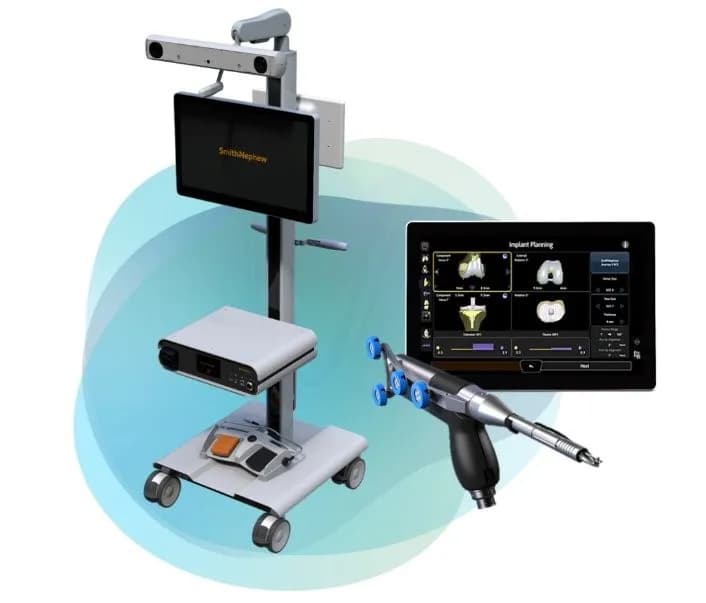
Robotic-assisted knee replacement uses a sophisticated surgical system controlled entirely by the surgeon, to plan and execute the procedure with a level of precision that goes beyond what manual techniques alone can achieve. At Apex Hospitals, this is performed using the Smith+Nephew CORI Surgical System, one of the most advanced platforms available for knee replacement surgery.
The process begins with a detailed mapping of the patient's knee anatomy, in CT-free robotic systems, this mapping happens in real time during surgery itself, without the need for a pre-operative CT scan. The robotic system builds a three-dimensional model of the individual patient's knee, taking into account the exact shape, size, and alignment of the bones.
Using this data, the surgeon plans the precise placement of the implant before making any cuts. During surgery, the robotic arm assists in executing those cuts with accuracy, operating within predefined boundaries. If the surgical instrument moves outside the planned safe zone, the system automatically restricts the movement, preventing accidental cuts to healthy bone or tissue.
Critically, the surgeon remains entirely in control throughout. The robot does not perform the surgery independently, it is a sophisticated tool that enhances the surgeon's precision and consistency.
Here is a direct comparison across the factors that matter most to patients:
| Robotic Knee Replacement | Traditional Knee Replacement | |
| Surgical Planning | CT-free 3D mapping of each patient's anatomy before and during surgery | Standard pre-operative X-rays; planning done manually by surgeon |
| Precision | Real-time robotic guidance ensures exact implant positioning | Depends entirely on surgeon's eye and experience |
| Incision Size | Smaller, more targeted incisions | Larger incision required for full access |
| Bone Removal | Only the diseased bone is removed; healthy bone preserved | Broader bone cuts; healthy tissue may be affected |
| Blood Loss | Significantly reduced | Higher blood loss typical |
| Hospital Stay | 2–3 days in most cases | 3–5 days typically |
| Recovery Time | Faster — most patients walk within 24 hours | Longer recovery; mobilization takes more time |
| Post-op Pain | Less pain due to minimal tissue trauma | More post-operative pain and swelling |
| Physiotherapy | Often shorter course needed | More intensive and longer course required |
| Implant Longevity | Higher — precise alignment reduces wear | Greater risk of early wear if alignment is off |
One of the most important factors in the long-term success of a knee replacement is how well the implant is aligned. A knee implant that sits even a few degrees off from the ideal position can change the way forces are distributed across the joint, leading to uneven wear, reduced range of motion, and a knee that does not feel quite natural.
Studies have consistently shown that malalignment is one of the leading causes of early implant failure and the need for revision surgery. It can also be the reason some patients continue to experience discomfort even after a technically successful procedure.
Robotic surgery addresses this directly. By planning the implant position based on the individual patient's anatomy, not a standard average, and by executing cuts within a precisely controlled range, robotic systems significantly reduce the risk of malalignment. This is particularly important for younger, more active patients, for whom implant longevity is a priority.
Recovery is one of the areas where patients notice the most tangible difference between the two approaches.
• Most patients are able to stand and take steps with support within 24 hours of surgery
• Hospital stay is typically 2 to 3 days
• Less post-operative pain, as smaller, more targeted incisions cause less trauma to surrounding tissue
• Physiotherapy is usually shorter in duration and progresses faster
• Return to light daily activities within 3 to 4 weeks in most cases
• Return to more active pursuits, walking longer distances, driving, climbing stairs; within 6 to 8 weeks
• Mobilization begins within 1 to 2 days, though progress may be slightly slower
• Hospital stay is typically 3 to 5 days
• More post-operative swelling and pain are common due to larger incisions and more extensive tissue handling
• Physiotherapy is an intensive and essential part of recovery, usually over several weeks to months
• Full recovery and return to activity typically take 3 to 6 months
Both approaches require commitment to physiotherapy. No surgery, however precise, produces a good outcome without rehabilitation. But the starting point and the pace of recovery tend to be more favorable with robotic surgery.
Most patients who are suitable for traditional knee replacement are also suitable for robotic knee replacement. The technology is not restricted to complex or high-risk cases, in fact, it benefits a wide range of patients.
Robotic knee replacement is particularly well-suited for:
• Younger, active patients for whom implant longevity is especially important
• Patients with significant deformity or unusual anatomy where standard sizing and alignment are more challenging
• Patients who want the fastest possible return to activity
• Those undergoing partial knee replacement, where precision in bone removal is especially critical
• Patients who have had previous knee surgery and require careful planning around existing hardware
Your orthopaedic surgeon will assess your specific condition, anatomy, and expectations to determine the most appropriate approach for you.
Robotic knee replacement does involve additional costs compared to traditional surgery, primarily related to the technology and the specialized training required to use it. However, the relevant question for most patients is not simply the upfront cost, but the total picture over time.
A more precisely placed implant lasts longer and is less likely to require revision surgery, which is itself a significantly more complex, costly, and physically demanding procedure. Shorter hospital stays, reduced physiotherapy requirements, and faster return to normal life also offset some of the additional investment.
Many insurance policies and government health schemes now cover robotic knee replacement. It is worth discussing coverage with your hospital's billing team before the procedure.
Consider consulting an orthopaedic specialist if you are experiencing:
• Persistent knee pain that is limiting your daily activities, walking, climbing stairs, getting up from a chair
• Knee pain that wakes you at night or persists even at rest
• Visible swelling or deformity of the knee joint
• Stiffness that significantly restricts your range of motion
• Loss of effectiveness from previously helpful treatments, medication, injections, or physiotherapy
The earlier an evaluation is done, the more options are available. Surgery is not always the first recommendation, but understanding where you stand allows for better planning.
At Apex Hospitals, our orthopaedic and joint replacement team offers both robotic and traditional knee replacement surgery, and will recommend the approach best suited to your individual condition, anatomy, and goals.
If you have been advised a knee replacement, or if persistent knee pain is affecting your quality of life, we encourage you to come in for a consultation. Understanding your options is the first step toward making the right decision for your health.
Medically reviewed by:
Senior Consultant – Orthopaedics, Joint Replacement & Sports Injury
MBBS, MS-Orthopaedics, FJRS (Fellowship in Robotic Joint Replacement Surgeries)
Apex Hospitals, Malviya Nagar, Jaipur

Download Our App


Powered By Docfyn