

Best Robotic Surgery Hospital in Jaipur for Orthopaedic & General Surgery
Best Robotic Surgery Hospital in Jaipur for Orthopaedic & General Surgery
How robotic-assisted technology is transforming surgical outcomes at Apex Hospitals — and what it means for patients in Rajasthan.
By the Apex Hospitals Clinical Team · Published July 2025
Surgery has always demanded precision — but for decades, that precision depended almost entirely on the steadiness of a surgeon's hand and the clarity of their field of view. Robotic surgery changes that equation. By combining real-time 3D imaging, AI-assisted planning, and haptic-feedback instruments, robotic platforms allow surgeons to operate with a level of accuracy that was simply not achievable through conventional open or even laparoscopic techniques.
In Jaipur, robotic surgery at Apex Hospitals has moved from a niche offering to a mainstream care pathway — particularly for knee replacement and select general surgical procedures. This article explains what robotic surgery actually involves, who benefits most, and how Apex Hospitals has built one of Rajasthan's most advanced robotic surgery programmes.
What Is Robotic Surgery — and How Does It Differ from Laparoscopy?
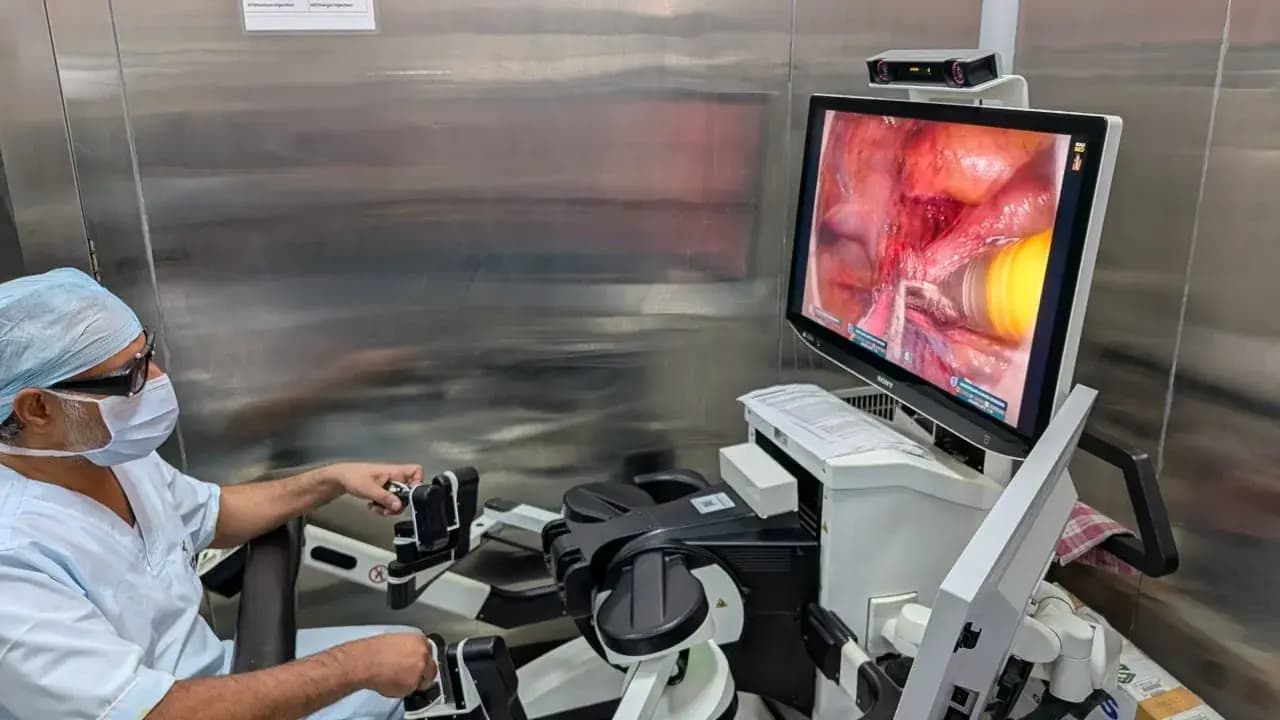
Many patients confuse robotic surgery with laparoscopic (keyhole) surgery. Both use small incisions and a camera, but the similarities largely end there. In laparoscopic surgery, the surgeon directly manipulates long-handled instruments while watching a 2D monitor. In robotic surgery, the surgeon sits at a console and controls articulated robotic arms that can rotate 360 degrees — far beyond the range of a human wrist — while viewing a magnified, high-definition 3D image of the operative field.
Crucially, the robot does not operate autonomously. Every movement is surgeon-directed in real time; the robotic system simply filters out hand tremor, scales down movements, and provides intraoperative data that guides decision-making. The result is smaller incisions, less blood loss, reduced post-operative pain, and faster return to normal activity — outcomes that are particularly meaningful for orthopaedic and abdominal procedures.
According to a 2021 review published on PubMed/NCBI, robotic-assisted surgery is associated with significantly lower complication rates and shorter hospital stays compared with conventional open surgery across multiple specialties.
Robotic Knee Replacement at Apex Hospitals: The CORI System
The flagship robotic technology at Apex Hospitals is the CORI Surgical System by Smith+Nephew — an imageless, handheld robotic platform that represents the current gold standard in knee replacement surgery. Unlike older robotic systems that require a pre-operative CT or MRI scan to build a bone model, CORI uses RI.KNEE real-time intraoperative 3D mapping to construct a patient-specific bone model on the operating table itself.
This has several practical advantages for patients:
No pre-operative CT or MRI required — reducing radiation exposure, cost, and waiting time before surgery.
AI-assisted implant planning — the system analyses bone geometry and soft-tissue balance intraoperatively, helping the surgeon select the optimal implant size and alignment.
29% faster bone resection and 5× faster system response compared with earlier robotic platforms, reducing anaesthesia time.
2× more cutting volume per pass, enabling more efficient and precise bone preparation.
The surgeon retains full control throughout — the robotic arm guides and constrains the cutting tool within a pre-defined safe zone, but cannot act independently.
For patients in Jaipur and across Rajasthan who have been living with chronic knee pain from osteoarthritis or injury, robotic orthopaedic surgery in Jaipur at Apex Hospitals offers a pathway to lasting relief with a recovery trajectory that is measurably better than conventional knee replacement.
Who Is a Candidate for Robotic Knee Replacement?
Robotic knee replacement is not reserved for any single age group or severity of disease. The most common candidates include:
Adults with moderate-to-severe knee osteoarthritis that has not responded adequately to physiotherapy, weight management, or injections.
Patients with significant joint deformity (varus or valgus alignment) where precise implant positioning is especially critical.
Younger, active patients who want a more durable implant outcome and a faster return to sport or physical work.
Patients who have had a previous knee surgery and require revision replacement.
A thorough pre-operative assessment by the orthopaedics team at Apex Hospitals — including weight-bearing X-rays, functional assessment, and a detailed discussion of patient goals — determines whether total or partial (unicompartmental) robotic knee replacement is most appropriate.
Robotic General Surgery: Minimally Invasive Abdominal Procedures
Beyond orthopaedics, Apex Hospitals has expanded its robotic surgery programme to include select general and gastrointestinal surgical procedures. Robotic platforms are particularly well-suited to operations in confined anatomical spaces — such as the pelvis and upper abdomen — where the articulated robotic wrist outperforms conventional laparoscopic instruments.
Procedures increasingly performed with robotic assistance at Apex include:
Cholecystectomy (gallbladder removal) — with reduced port-site pain and faster discharge.
Hernia repair (inguinal and ventral) — robotic mesh placement allows more precise fixation with lower recurrence risk.
Colorectal resections — particularly for rectal cancer, where pelvic anatomy demands extreme precision to preserve continence and sexual function.
Bariatric procedures — robotic assistance in sleeve gastrectomy and gastric bypass improves anastomotic precision.
Patients considering gastrointestinal surgery in Jaipur or bariatric surgery at Apex Hospitals can discuss robotic options during their surgical consultation.
Oncological Robotic Surgery: The Make-in-India System
Apex Hospitals also operates an indigenously developed Make-in-India Robotic Surgery System for select oncological procedures — including urological and gastrointestinal cancers. This platform enables precise, minimally invasive cancer surgery with faster recovery and reduced post-operative complications, making it a meaningful option for patients who might otherwise face prolonged open-surgery recovery.
For patients navigating a cancer diagnosis, the oncology team at Apex Hospitals works alongside the surgical team to determine whether robotic resection is appropriate as part of a multimodal treatment plan.
What Sets Apex Hospitals Apart as a Robotic Surgery Centre in Jaipur
CORI Robotic System with RI.KNEE technology — one of the most advanced imageless knee replacement platforms available in Rajasthan, eliminating the need for pre-operative CT scans.
NABH-accredited facility with modular operating theatres, emergency OTs available 24×7, and on-site CT, MRI, and emergency labs for comprehensive peri-operative support.
Integrated rehabilitation pathway — the in-house physiotherapy and rehabilitation unit at Apex ensures patients begin structured mobilisation within 24 hours of robotic knee replacement, accelerating functional recovery.
Multi-specialty robotic capability — orthopaedic, general, gastrointestinal, and oncological robotic procedures under one roof, supported by 70+ doctors across 30+ sub-specialties.
Empanelled under Ayushman Bharat and major insurance/TPA schemes, making robotic surgery accessible to a broader patient population across Rajasthan.
Recognised innovation — Apex Hospitals is a USAID Grant Winner, Digital Transformation Award 2022 recipient, and has been featured in the Harvard Business Review for its HOPE Tele-ICU programme, reflecting an institutional culture of clinical and technological advancement.
The Patient Journey: From Consultation to Recovery
Understanding the care pathway helps patients feel prepared and confident. At Apex Hospitals, the robotic surgery journey typically follows these stages:
Initial consultation — the surgeon reviews imaging, functional history, and patient goals to confirm candidacy for robotic surgery.
Pre-operative workup — blood tests, cardiac clearance, and anaesthesia assessment are completed; for CORI knee replacement, no CT or MRI is needed.
Surgery day — the procedure is performed under spinal or general anaesthesia in a modular OT; most robotic knee replacements take 60–90 minutes.
Early mobilisation — physiotherapy begins the day after surgery; most patients take their first steps within 24 hours.
Discharge and follow-up — patients are typically discharged within 3–5 days and attend structured outpatient physiotherapy sessions at the in-house rehabilitation unit.
Patients travelling from outside Jaipur — including from Sawai Madhopur, Jhunjhunu, Bikaner, Sri Ganganagar, and Udaipur — can access Apex's network of eight locations for follow-up care, reducing the burden of long-distance travel during recovery.
Robotic Surgery and Critical Care: A Safety Net That Matters
One aspect of robotic surgery that patients rarely consider in advance — but deeply appreciate when it matters — is the quality of the critical care infrastructure behind the operating theatre. At Apex Hospitals, every robotic procedure is backed by a dedicated ICU and critical care unit with ECMO capability, a Cardiac ICU, Neuro ICU, and Trauma ICU.
The hospital's ECMO programme has achieved an 80% survival rate in cases requiring extracorporeal membrane oxygenation — one of the strongest outcomes in Rajasthan. While the vast majority of robotic surgery patients never require ICU-level care, knowing that this safety net exists is a meaningful reassurance for patients with complex comorbidities.
Common Questions About Robotic Surgery
Is robotic surgery safe?
Yes. Robotic surgery platforms are cleared by regulatory bodies worldwide and have been used in millions of procedures globally. The surgeon remains in full control throughout; the robotic system enhances precision but cannot act independently. At Apex Hospitals, all robotic procedures are performed by experienced surgeons in NABH-accredited operating theatres.
Does robotic knee replacement hurt more than conventional surgery?
Most patients report less post-operative pain with robotic knee replacement compared with conventional surgery, because the precision of bone preparation reduces soft-tissue trauma around the joint. Pain management protocols at Apex include multimodal analgesia and early physiotherapy to minimise discomfort during recovery.
How long does recovery take after robotic knee replacement?
Most patients are walking with support within 24 hours of surgery and are discharged within 3–5 days. Return to light daily activities typically occurs within 4–6 weeks; full recovery and return to sport or physically demanding work generally takes 3–6 months, depending on individual factors and adherence to physiotherapy.
Is robotic surgery covered by insurance in India?
Coverage varies by insurer and policy. Apex Hospitals is empanelled under Ayushman Bharat and multiple TPA and insurance schemes. The hospital's billing team can assist patients in verifying coverage before surgery.
Can I get robotic surgery at Apex Hospitals if I live outside Jaipur?
Yes. Apex Hospitals operates across eight locations in Rajasthan and Lucknow. Patients from other cities can have their initial consultation and pre-operative workup at a nearby Apex branch, travel to Jaipur for the robotic procedure, and return to their local branch for follow-up physiotherapy and monitoring.
References
Considering Robotic Surgery in Jaipur?
Speak with the robotic surgery team at Apex Hospitals, Malviya Nagar, Jaipur — call 098290 30011 or book a consultation online to find out whether robotic-assisted surgery is right for you.