
A clinically grounded guide to understanding aplastic anemia severity, transplant eligibility, and what modern BMT outcomes look like for patients in India.
By the Apex Hospitals Editorial Team · Published July 2025
Aplastic anemia is a rare but life-threatening condition in which the bone marrow stops producing enough blood cells — red cells, white cells, and platelets — leaving the body vulnerable to severe infections, uncontrolled bleeding, and profound fatigue. For many patients and families, the diagnosis raises an immediate and urgent question: is a bone marrow transplant necessary, and if so, when?
The answer depends on several factors: the severity of the disease, the patient's age, the availability of a matched donor, and how the patient has responded to earlier treatments. This article walks through the clinical decision-making process in plain language, drawing on established haematology guidelines and the expertise of the haemato-oncology team at Apex Hospitals.
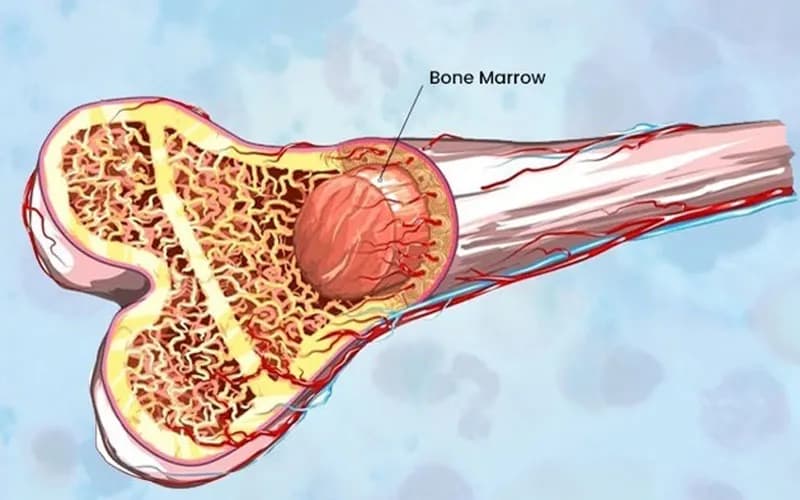
Aplastic anemia occurs when the body's immune system mistakenly attacks the haematopoietic stem cells in the bone marrow, or when those stem cells are damaged by toxins, radiation, or certain medications. The result is a hypocellular marrow — one that is largely empty of the precursor cells needed to manufacture blood.
Clinicians classify aplastic anemia into three severity categories based on blood counts:
Non-severe aplastic anemia (NSAA): Blood counts are reduced but do not meet the criteria for severe disease. Many patients can be monitored or managed with supportive care initially.
Severe aplastic anemia (SAA): At least two of the following — absolute neutrophil count below 0.5 × 10⁹/L, platelet count below 20 × 10⁹/L, reticulocyte count below 20 × 10⁹/L — with a hypocellular marrow. This category carries significant mortality risk without treatment.
Very severe aplastic anemia (vSAA): As above, but with an absolute neutrophil count below 0.2 × 10⁹/L. This is a haematological emergency.
According to data published by the National Institutes of Health (NIH), aplastic anemia affects approximately 2–3 people per million annually in Western countries, with higher incidence rates reported in Asia — making it a particularly relevant condition for patients across India.
Without treatment, severe and very severe aplastic anemia carry a mortality rate exceeding 70% within one year, primarily from overwhelming infection or haemorrhage. Even non-severe disease can progress to a more dangerous stage over time. Early diagnosis and prompt specialist referral are therefore critical.
Patients with untreated aplastic anemia also face a long-term risk of clonal evolution — the emergence of related blood disorders such as myelodysplastic syndrome (MDS) or acute myeloid leukaemia (AML). This risk underscores why watchful waiting is rarely appropriate for moderate-to-severe disease.
If you or a family member has been diagnosed with aplastic anemia, early evaluation by a specialist in bone marrow transplant in Jaipur can help determine the right treatment pathway before the condition worsens.
Not every patient with aplastic anemia requires a bone marrow transplant. The two main treatment pathways are:
For patients who do not have a matched sibling donor, or who are older (typically above 40–50 years), immunosuppressive therapy — usually a combination of anti-thymocyte globulin (ATG), cyclosporine, and eltrombopag — is the first-line approach. IST works by suppressing the immune attack on the marrow and stimulating residual stem cells. Response rates with modern IST regimens have improved significantly, with overall response rates of 60–80% reported in clinical literature. However, IST does not cure the underlying disease and relapse remains a concern.
An allogeneic stem cell transplant — where healthy stem cells from a matched donor are infused to rebuild the patient's bone marrow — is the only potentially curative treatment for aplastic anemia. It replaces the faulty immune system and the damaged marrow simultaneously. The transplant programme at Apex Hospitals covers a range of haematopoietic stem cell transplant procedures, supported by a dedicated ICU and critical care infrastructure.
Current international guidelines — including those from the European Society for Blood and Marrow Transplantation (EBMT) — recommend upfront allogeneic BMT in the following situations:
Severe or very severe aplastic anemia in patients under 40 who have a matched sibling donor (MSD). In this group, BMT is the preferred first-line treatment because outcomes are superior to IST and the risk of transplant-related complications is lower in younger patients.
Failure of immunosuppressive therapy — patients who do not respond to one or two courses of IST, or who relapse after initial response, are candidates for BMT regardless of age, provided a suitable donor is available.
Transfusion-dependent patients who are accumulating iron overload and deteriorating on supportive care alone.
Clonal evolution — if aplastic anemia has progressed to MDS or another clonal disorder, transplant becomes more urgent.
For patients between 40 and 60 with a matched sibling donor, the decision is individualised — weighing transplant-related mortality against the long-term risks of IST dependence. Patients above 60 are generally offered IST first, though fit older patients with matched unrelated donors (MUD) may still be considered for reduced-intensity conditioning transplants.
Donor matching is based on human leukocyte antigen (HLA) typing. The closer the HLA match, the lower the risk of graft-versus-host disease (GvHD) — a serious complication in which the donor immune cells attack the recipient's tissues.
Matched Sibling Donor (MSD): A fully HLA-matched brother or sister. This is the gold standard. Approximately 25–30% of patients will have an MSD.
Matched Unrelated Donor (MUD): A volunteer donor identified through national or international registries with a high-resolution HLA match. Outcomes with MUD transplants have improved substantially with better conditioning regimens and GvHD prophylaxis.
Haploidentical Donor: A half-matched family member — typically a parent, child, or sibling. Haploidentical transplants have become increasingly viable with post-transplant cyclophosphamide (PTCy) protocols, expanding donor availability for patients without a fully matched donor.
Cord Blood: Less commonly used for aplastic anemia due to lower cell doses, but may be considered in specific paediatric cases.
The haematology specialists at Apex Hospitals perform comprehensive HLA typing and donor workup to identify the safest and most appropriate donor for each patient.
Success rates for BMT in aplastic anemia have improved markedly over the past two decades. For young patients (under 20) receiving a matched sibling donor transplant, long-term overall survival rates of 85–95% are reported at experienced centres. For matched unrelated donor transplants, five-year survival rates of 70–80% are achievable with modern protocols.
In India, outcomes at high-volume transplant centres are increasingly comparable to international benchmarks. Factors that influence success include:
Patient age and overall fitness (performance status)
Degree of HLA match between donor and recipient
Number of prior blood transfusions (higher transfusion burden increases sensitisation risk)
Time from diagnosis to transplant — earlier transplant generally yields better outcomes
Quality of supportive care infrastructure, including ICU and critical care capabilities during the engraftment period
A 2018 review published on PubMed confirmed that outcomes for aplastic anemia BMT in Asian centres have steadily improved, with matched sibling donor transplants achieving survival rates comparable to Western data when performed at experienced institutions.
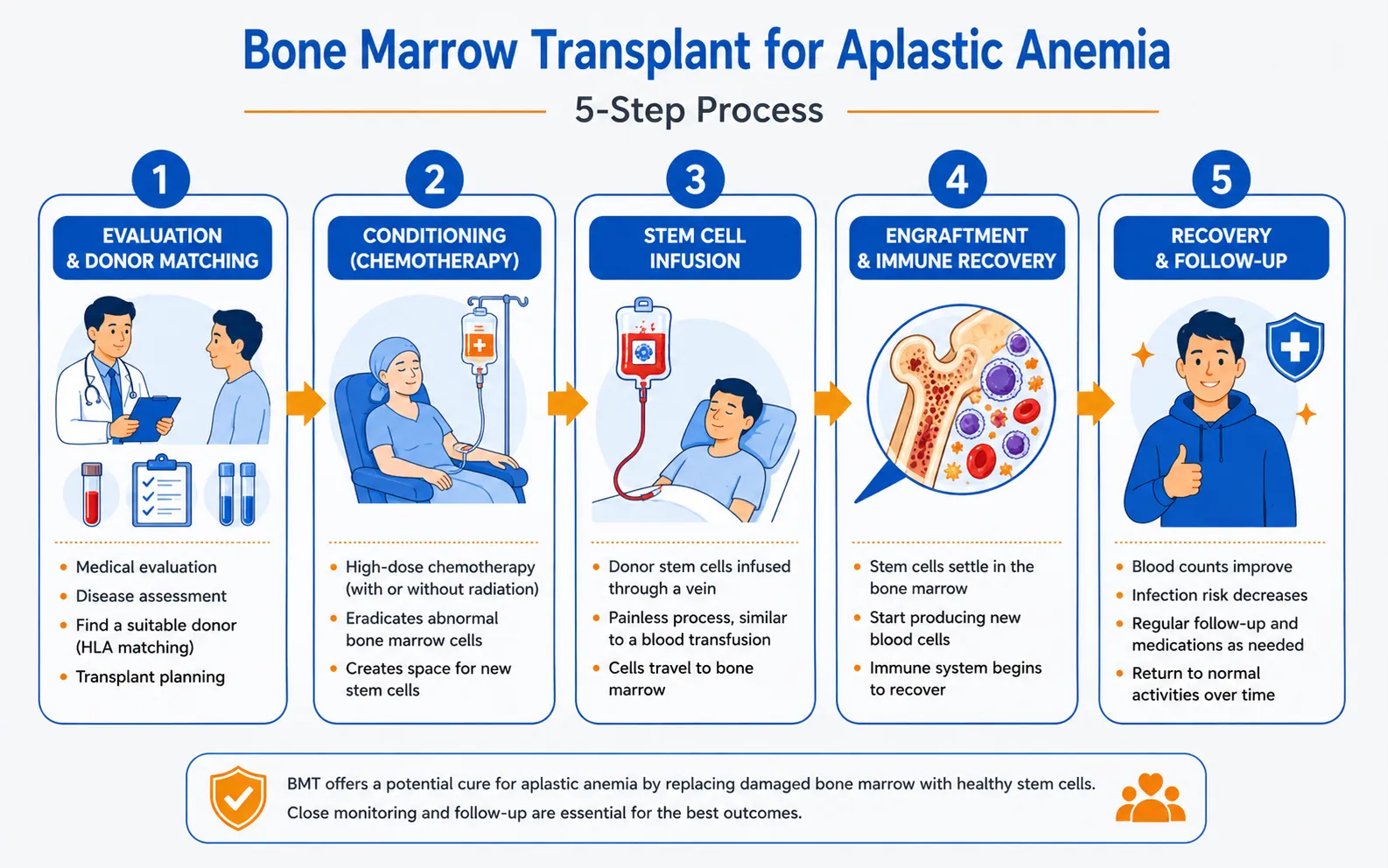
The patient undergoes a thorough assessment including bone marrow biopsy, HLA typing, organ function tests, and infectious disease screening. The donor is simultaneously evaluated. This phase typically takes 2–4 weeks.
Before the transplant, the patient receives a conditioning regimen — a combination of chemotherapy (and sometimes low-dose radiation) designed to suppress the immune system and clear space in the marrow for the donor cells. For aplastic anemia, conditioning is typically non-myeloablative or reduced-intensity to minimise organ toxicity.
The donor's stem cells — collected either from the bone marrow directly or from peripheral blood after growth factor stimulation — are infused intravenously. The procedure itself resembles a blood transfusion.
The donor cells travel to the marrow and begin producing new blood cells. This is the most vulnerable period — the patient is at high risk of infection and bleeding. Close monitoring in a specialist transplant unit with dedicated critical care support is essential.
After engraftment, patients are monitored for graft-versus-host disease, infection, and graft failure. Immunosuppressive medications are gradually tapered over 6–12 months as the new immune system stabilises.
Recovery from BMT is a gradual process measured in months, not days. Here is a general timeline:
Weeks 1–4 (in-hospital): Engraftment phase. The patient remains hospitalised in a protective environment, receiving transfusions, antibiotics, and antifungal prophylaxis as needed.
Months 1–3 (early outpatient): Frequent clinic visits for blood count monitoring, GvHD assessment, and medication adjustments. Most patients can return home but must avoid crowded places and infection risks.
Months 3–12 (immune reconstitution): The new immune system gradually strengthens. Patients resume normal activities incrementally. Vaccinations are re-administered as the immune system rebuilds.
Year 1 and beyond: Most patients who achieve full engraftment without significant GvHD can expect a return to near-normal quality of life. Annual follow-up continues for several years to monitor for late effects.
Nutritional support during recovery is an important but often overlooked component. The dietetics and nutrition team at Apex Hospitals works alongside the haematology unit to help transplant patients maintain adequate caloric and micronutrient intake throughout the recovery period.
Physiotherapy and rehabilitation also play a role in rebuilding strength and stamina after prolonged hospitalisation. The physiotherapy and rehabilitation department at Apex Hospitals provides structured programmes tailored to post-transplant patients.
Aplastic anemia can affect children and adolescents, and the approach differs from adult management in important ways. Children tolerate conditioning regimens better and have superior long-term outcomes after BMT compared to adults. For a child with severe aplastic anemia and a matched sibling donor, transplant is almost universally recommended as first-line therapy.
The paediatrics and child care team at Apex Hospitals collaborates closely with haematology specialists to manage young patients with aplastic anemia, ensuring age-appropriate care and family support throughout the treatment journey.
BMT is recommended as first-line treatment for patients under 40 with severe or very severe aplastic anemia who have a matched sibling donor. It is also recommended for patients of any age who have failed one or more courses of immunosuppressive therapy, or whose disease has evolved into a clonal disorder such as MDS.
At experienced transplant centres in India, matched sibling donor BMT for aplastic anemia achieves long-term survival rates of 85–95% in younger patients. Matched unrelated donor transplants yield 70–80% five-year survival with modern protocols. Outcomes are strongly influenced by patient age, donor match quality, and the centre's transplant volume and supportive care infrastructure.
The ideal donor is a fully HLA-matched sibling. When no sibling match is available, a matched unrelated donor from a registry or a haploidentical family member (parent, child, or half-matched sibling) may be used. Advances in haploidentical transplantation have significantly expanded donor availability.
Initial hospitalisation lasts approximately 3–5 weeks. Most patients require close outpatient monitoring for the first 3 months. Full immune reconstitution takes 6–12 months. Many patients return to near-normal daily activities within 6–9 months, though annual follow-up continues for several years.
Untreated severe aplastic anemia carries a mortality rate above 70% within one year, primarily from infection or bleeding. Even non-severe disease can progress. There is also a long-term risk of clonal evolution to myelodysplastic syndrome or acute leukaemia. Early specialist evaluation is strongly advised.
Yes, for patients who are not transplant candidates — due to age, lack of a suitable donor, or comorbidities — immunosuppressive therapy with ATG, cyclosporine, and eltrombopag is an effective alternative. However, IST is not curative and carries relapse and clonal evolution risks. BMT remains the only potentially curative option.
The haemato-oncology team at Apex Hospitals can help you understand your diagnosis, explore donor options, and determine whether a bone marrow transplant is the right path for you or your loved one.