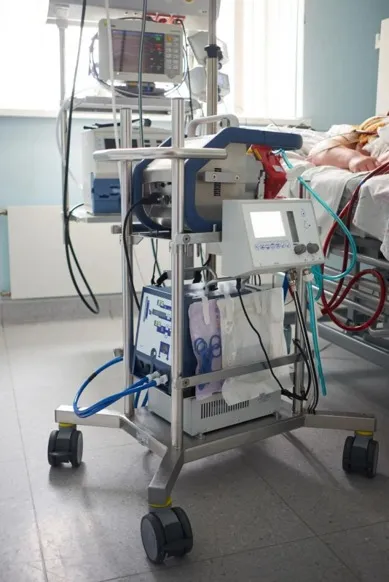
Normally, ECMO can only be given at large specialised hospitals. This means very sick patients have to be moved first, which is often too dangerous.
Apex Hospitals changes this.
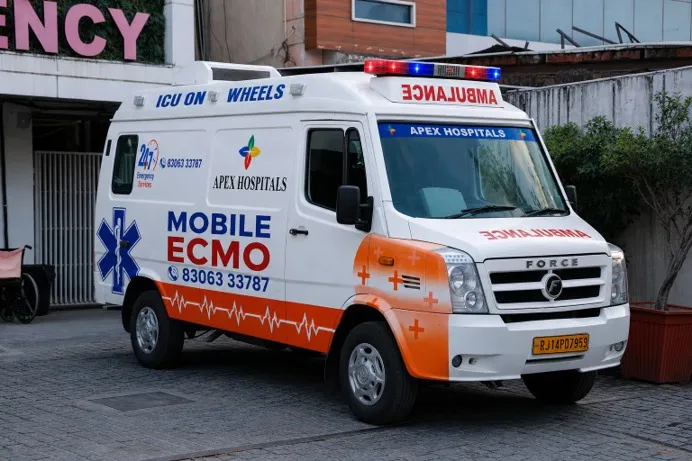
We send our ECMO team directly to the patient's hospital. We start the ECMO there, make the patient stable, and only then bring them safely to Apex Hospitals, in our specially equipped ECMO ambulance.
Mobile ECMO Services in Rajasthan | Apex Hospitals
24/7 Mobile ECMO Ambulance Service | Apex Hospitals
Quick Appointment
Fill in your details to get started
Mobile ECMO
ECMO stands for Extracorporeal Membrane Oxygenation. In simple terms, it is a machine that does the work of the heart and lungs when they are too weak to work on their own.
The machine gently draws blood out of the body, adds oxygen to it, and pumps it back in, supporting blood circulation and oxygen delivery while doctors treat the underlying cause.
Think of it as a temporary support system that buys time, time for the heart or lungs to recover, or time to plan the next step in treatment.
When is ECMO used?
•When the heart is failing and medicines are not enough
•When the lungs cannot get enough oxygen into the blood
•When the heart has stopped and CPR alone is not working
•As a bridge while waiting for a heart or lung transplant
What does ECMO do for the patient?
•Keeps the blood flowing to the brain and organs
•Gives the heart and lungs time to rest and recover
•Stabilises the patient so proper treatment can begin
ECMO stands for Extracorporeal Membrane Oxygenation. In simple terms, it is a machine that does the work of the heart and lungs when they are too weak to work on their own.
The machine gently draws blood out of the body, adds oxygen to it, and pumps it back in, supporting blood circulation and oxygen delivery while doctors treat the underlying cause.
Think of it as a temporary support system that buys time, time for the heart or lungs to recover, or time to plan the next step in treatment.
When is ECMO used?
•When the heart is failing and medicines are not enough
•When the lungs cannot get enough oxygen into the blood
•When the heart has stopped and CPR alone is not working
•As a bridge while waiting for a heart or lung transplant
What does ECMO do for the patient?
•Keeps the blood flowing to the brain and organs
•Gives the heart and lungs time to rest and recover
•Stabilises the patient so proper treatment can begin
Our Mobile ECMO Ambulance
Our ambulance is not an ordinary ambulance. It carries the full ECMO machine, breathing support equipment, medicines, and a trained specialist team, everything needed to start ECMO at any hospital and keep the patient safe during the journey.
Step 1: We Come to You
Our team and ambulance reach your hospital as quickly as possible
Step 2: We Start ECMO
ECMO is started at the patient's bedside and they are made stable
Step 3: Safe Transfer
Patient travels to Apex Hospitals on ECMO, monitored every second of the journey
Our ambulance is not an ordinary ambulance. It carries the full ECMO machine, breathing support equipment, medicines, and a trained specialist team, everything needed to start ECMO at any hospital and keep the patient safe during the journey.
Step 1: We Come to You
Our team and ambulance reach your hospital as quickly as possible
Step 2: We Start ECMO
ECMO is started at the patient's bedside and they are made stable
Step 3: Safe Transfer
Patient travels to Apex Hospitals on ECMO, monitored every second of the journey
When Should You Consider ECMO?
The earlier you call us, the better the chances for the patient. You do not need to wait until things become critical. If the patient is getting worse despite treatment, it is time to call.
Heart Problems-2
•The heart is failing and medicines to support it are not working
•Very low blood pressure that is not improving with treatment
•Heart attack with severe heart failure
•Dangerous heart rhythms that keep coming back
•Heart has stoppedand CPR has been going on but is not working
•Severe heart failure after heart surgery
Lung Problems-1
•The lungs are severely infected or damaged and the patient cannot get enough oxygen even on a ventilator
•Too much carbon dioxide building up in the blood that medicines cannot control
•Severe asthma attack that is life-threatening
•Waiting for a lung transplant and condition is worsening
Other Situations
•Very low body temperature causing the heart to stop
•Drug overdose causing severe heart failure
•Near-drowning with heart involvement.
What Happens Without Mobile ECMO?
Without Mobile ECMO, doctors at referring hospitals face a very difficult choice when a patient is too sick to move safely.
The risk without Mobile ECMO:
•The patient becomes too unstable for the treating hospital to manage
•Moving the patient to another hospital is too risky, but staying is also dangerous
•The patient's heart or lungs may give up during the transfer
•By the time the patient reaches an ECMO centre, it may be too late
Mobile ECMO removes this risk. We come to the patient, start ECMO there, and only move them once they are stable.
Step-by-Step: What Happens When You Call Us
1
You call our helpline
Our ECMO doctor picks up immediately and starts advising your team while we prepare to come
2
Our team is on the way
Our ECMO ambulance with the full specialist team leaves for your hospital
3
We assess the patient
Our team arrives and quickly reviews the patient at the bedside
4
ECMO is started
We begin ECMO at your hospital. The patient's condition starts to stabilise
5
Safe journey to Apex
We move the patient to our hospital in the ECMO ambulance, with the team monitoring every moment
6
Full care at Apex Hospitals
Our full team takes over — heart specialists, lung specialists, surgeons, and more — all working together
Types of ECMO We Offer
VA ECMO — Heart and Lung Support
VA stands for Veno-Arterial. This type of ECMO supports both the heart and the lungs at the same time. It takes over the pumping work of the heart as well as the breathing work of the lungs.
Used when:
•The heart is failing severely
•The heart has stopped (cardiac arrest)
•After heart surgery when the heart is too weak to pump on its own
VV ECMO — Lung Support
VV stands for Veno-Venous. This type of ECMO supports only the lungs. The patient's own heart is still working — the machine simply helps with breathing by cleaning the blood and adding oxygen to it.
Used when:
•The lungs are severely damaged or infected
•The patient cannot get enough oxygen even on a ventilator
•As a bridge while waiting for a lung transplant
ECPR — ECMO During Cardiac Arrest
ECPR is when ECMO is used during an active cardiac arrest — when the heart has stopped and normal CPR (chest compressions) alone is not enough to save the patient. ECMO takes over blood circulation, keeping the brain and organs alive while doctors treat the cause of the arrest.
Best candidates:
•Arrest was witnessed and CPR was started within minutes
•CPR has been going on for less than an hour
•There is a treatable cause (e.g. heart attack, drug overdose, very low body temperature)
Expert Guidance Before We Arrive
The moment you call our helpline, our ICU doctor is on the call with you. You do not have to wait for our team to reach your hospital before getting help.Through a video call, our doctor can see the patient, guide your team on treatment, and help keep the patient as stable as possible until we arrive.
We will help you with:
•Adjusting the ventilator settings
•Choosing the right medicines to support blood pressure
•Deciding if ECMO is the right option for this patient
•Keeping the patient stable until our team arrives
Please keep these reports ready:
•Latest blood gas report (ABG)
•Echocardiography (heart scan) if done
•ECG and recent blood test reports
•Brief history of the patient's condition
A Full Team Behind Every Patient
ECMO is managed by a large team of specialists working together — not just one doctor. At Apex Hospitals, every ECMO patient has a dedicated team that includes:
Doctors
•Critical Care (ICU) Specialists
•Heart Specialists
•Heart Surgeons
•Lung Specialists
Specialist Team
•ECMO Machine Specialists (Perfusionists)
•Trained ICU Nurses
•Breathing Therapists
Support Specialists
•Kidney Specialists
•Blood Specialists
•Transplant & Rehabilitation Teams
Available 24 Hours, 7 Days a Week
Heart attacks and emergencies do not happen only during office hours. Our Mobile ECMO team is on standby every hour of every day, including weekends and public holidays.
What we guarantee:
•An ECMO doctor available on call at all times
•Video guidance from the moment you call
•Team and ambulance ready to leave within the hour
•ECMO machine always checked and ready to go
One call gets you:
✓Immediate expert advice
✓Our team on the way to you
✓Safe transfer on ECMO
✓Full specialist care at Apex
When to Refer — A Simple Guide for Doctors
If your patient meets any of the signs below, please call us immediately. When in doubt, call anyway, our team will help you decide.
Heart / Circulation
Lungs / Breathing
•Very low blood pressure not responding to multiple medicines
•Signs that organs are not getting enough blood (rising lactate)
•Heart pumping very poorly on echo
•Dangerous heart rhythms that keep coming back
•Witnessed cardiac arrest with a treatable cause
•Oxygen levels dangerously low despite maximum ventilator support
•Too much carbon dioxide building up, blood becoming very acidic
•Severely damaged lungs (e.g. severe pneumonia, ARDS)
•Life-threatening asthma not responding to treatment