
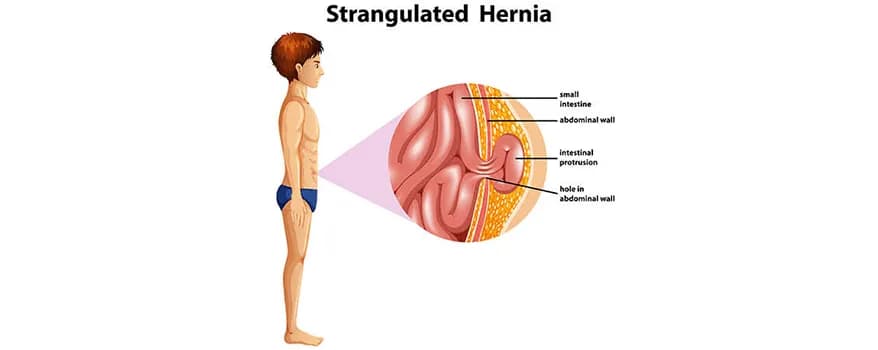
A hernia develops when a portion of internal organs protrudes through a weak spot or opening in the surrounding muscle or tissue. Typically, hernias involve an abdominal organ pushing through one of the walls of the abdominal cavity. These conditions can arise gradually over time due to natural muscle weakening associated with aging, or they can be precipitated by factors such as injury, surgical procedures, or congenital abnormalities.
The inguinal hernia stands as the most frequent type. It transpires when intestines protrude through a weak spot or tear in the lower abdominal wall, typically within the inguinal canal in the groin area. This canal serves as the passage for the spermatic cord in men and contains the round ligament in women, responsible for supporting the uterus.
A hiatal hernia occurs when a portion of the stomach protrudes through the diaphragm into the chest cavity. This type is prevalent among individuals over 50; in children, it's often due to congenital anomalies. Hiatal hernias commonly trigger gastroesophageal reflux disease (GERD), resulting in backward leakage of stomach contents into the oesophagus.
Primarily affecting children and babies, umbilical hernias manifest when the intestines bulge through the abdominal wall near the belly button. Although most umbilical hernias resolve spontaneously as abdominal muscles strengthen by ages 1 or 2, surgical intervention may be necessary if the hernia persists beyond 5 years. Adults can also develop umbilical hernias due to factors like obesity, ascites, or pregnancy.
This type occurs when tissue protrudes through an opening in the abdominal muscles, often diminishing in size when lying down. While ventral hernias can be congenital, they're frequently acquired later in life due to factors such as obesity, pregnancy, strenuous activity, or surgical incisions, leading to incisional hernias.
Apart from incisional hernias, which are a complication arising from abdominal surgery, the exact cause of a hernia often remains elusive. Nonetheless, the risk of herniation escalates with age and is more prevalent in men than in women.
Hernias can either be congenital, present at birth, or develop in children with a weakened abdominal wall. Certain activities and medical conditions that exert pressure on the abdominal wall can precipitate hernias, including:
Hernias can develop in various locations, including:
The risk factors vary depending on the type of hernia:
An incisional hernia typically occurs as a consequence of prior abdominal surgery, making recent surgical procedures the most apparent risk factor. Individuals are most vulnerable within 3-6 months following the surgery, particularly if:
These factors exert additional stress on the healing tissue, increasing the likelihood of herniation.
In infants, umbilical hernias are frequently observed in those with low birth weight and premature birth.
In adults, the risk factors encompass:
In numerous instances, a hernia manifests as a painless swelling that poses no immediate concerns and requires no urgent medical intervention.
However, a hernia can cause discomfort and pain, particularly worsening symptoms when standing, straining, or lifting heavy objects. Individuals noticing escalating swelling or soreness often seek medical evaluation.
In specific scenarios, prompt surgical intervention may be necessary, such as when a segment of the intestine becomes obstructed or strangulated by an inguinal hernia. Immediate medical attention is warranted if an inguinal hernia triggers acute abdominal symptoms, including:
In such instances, the swelling typically feels firm and tender and cannot be manually reduced.
A hiatal hernia may elicit symptoms of acid reflux, such as heartburn, stemming from stomach acid refluxing into the oesophagus.
If a hernia bulge exhibits redness, purple discoloration, or darkening, or if you detect any indications of a strangulated hernia, it is imperative to seek prompt medical attention.
Consult your doctor if you experience a painful or conspicuous bulge in your groin on either side of your pubic bone. The bulge tends to be more evident when standing, and you can typically palpate it by placing your hand directly over the affected region.

Download Our App


Powered By Docfyn