
By Apex Hospitals, 27th April, 2026
Most people picture Parkinson's disease as shaking hands. And while tremors are one of its most recognizable features, Parkinson's is far more complex than that, and far more common than most people realize.
In India, an estimated 1 in 100 people over the age of 60 lives with Parkinson's disease. Yet many cases go undiagnosed for years, either because the early signs are subtle and easy to dismiss, or because awareness of the condition remains limited.
This article explains what Parkinson's disease is, what its early warning signs look like, how the condition progresses, and what life with Parkinson's actually involves, for the patient and for the family.
Parkinson's disease is a progressive neurological condition that primarily affects movement, and over time, several other functions of the body and mind. It occurs when the brain gradually loses its ability to produce dopamine, a chemical messenger that plays a central role in coordinating smooth, controlled movement.
The region most affected is the substantia nigra, a part of the brain responsible for the majority of dopamine production. As the cells in this area deteriorate, dopamine levels fall and the brain's ability to regulate movement becomes increasingly impaired.
What triggers this deterioration is not fully understood. A combination of genetic factors, environmental exposures, and ageing is believed to be involved. In most cases, Parkinson's is not inherited, the majority of patients have no family history of the condition.
This is where awareness matters most. The early signs are often dismissed as normal ageing or stress-related symptoms. Recognizing them early, and acting on them, gives patients the best possible chance of managing the condition effectively.
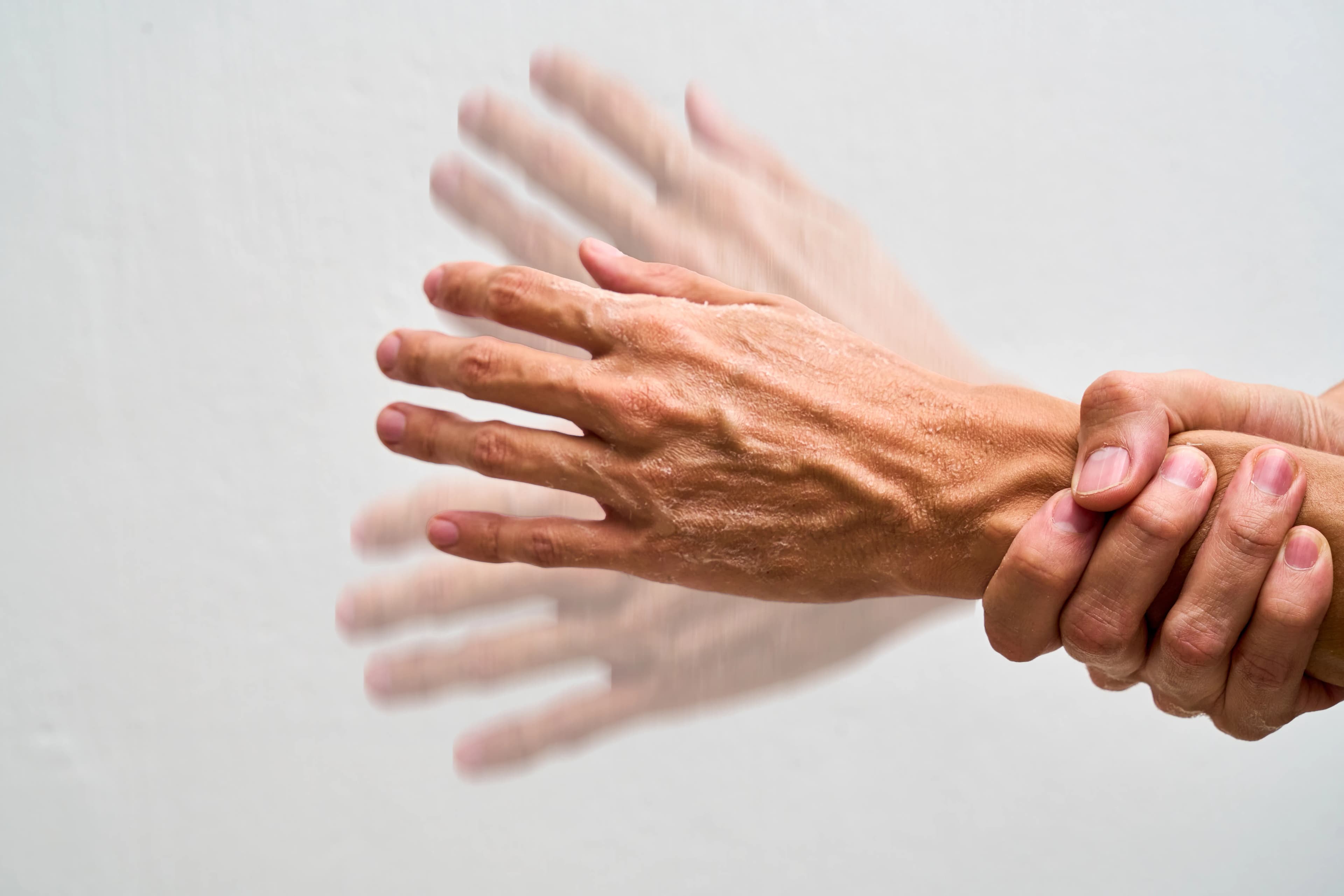
A slight trembling or shaking in a hand, finger, or chin, particularly when the limb is at rest and not being used, is often the first noticeable sign. This differs from the tremor caused by holding something heavy or feeling anxious. A Parkinson's tremor tends to reduce when the hand is in use and returns when it is at rest.
Many patients describe a feeling of tightness or stiffness in the arms, legs, or neck that does not ease with movement. This rigidity can restrict normal range of motion. A family member may notice that the person's arm no longer swings naturally when they walk.
Tasks that were once automatic and effortless, buttoning a shirt, writing, getting up from a chair, begin to take noticeably longer. The person may shuffle their feet rather than taking full steps. Handwriting may become smaller and more cramped over time, a specific sign known as micrographia.
A gradual stooping or forward lean, where the person begins to stand or walk in a slightly hunched position, can appear early and is easy to miss.
If you or a family member is noticing more than one of these signs, particularly in combination, it is worth speaking to a neurologist. A single symptom in isolation does not confirm a diagnosis, but a pattern warrants evaluation.
Parkinson's is a progressive condition, meaning it advances over time. The Hoehn and Yahr scale, widely used by neurologists, describes five stages of progression. Importantly, the pace of progression varies significantly from person to person, many people remain in the earlier stages for years.
Symptoms are present but mild and typically affect only one side of the body. Daily life is largely unaffected. A slight tremor, change in posture, or altered facial expression may be noticeable, but the person manages independently without difficulty.
Symptoms begin to appear on both sides of the body. Walking and posture may be affected. Daily tasks take more time and effort, but the person is still able to live independently. Balance remains intact at this stage.
This mid-stage is characterized by noticeable balance impairment, making falls a greater risk. The person can still live independently and perform most activities, but physical tasks are significantly slowed.
Symptoms are severe enough that independent living becomes unsafe. The person may be able to stand and walk with assistance, but requires help with many daily activities. Caregiver support becomes essential at this stage.
In the most advanced stage, the person is typically unable to stand or walk without significant assistance and may require a wheelchair or full-time care. Cognitive symptoms, including dementia, may also be present.
| Early / Mild Stage | Advanced Stage |
Movement | Mild tremor or stiffness on one side | Significant slowness, rigidity on both sides |
Balance | Largely intact | Impaired — falls become a risk |
Daily Activities | Independent, tasks take slightly longer | Require assistance; independent living unsafe |
Speech | Slightly softer or monotone | Significantly reduced volume and clarity |
Cognition | Usually, unaffected | Memory and thinking may be impaired |
Care Needed | Self-managed with medication | Full-time caregiver support required |
Parkinson's is often described as a movement disorder, but its impact extends well beyond movement. Non-motor symptoms can be just as debilitating, and in some cases, they appear before the physical symptoms do.
These include:
• Depression and anxiety — more common in Parkinson's patients than in the general population, and a direct result of changes in brain chemistry, not simply a reaction to the diagnosis
• Cognitive changes — ranging from mild memory difficulties to dementia in later stages
• Autonomic dysfunction — fluctuations in blood pressure, bladder problems, and excessive sweating
• Fatigue, chronic pain, and difficulty swallowing
Addressing non-motor symptoms is an important part of comprehensive Parkinson's care. Patients should feel comfortable raising these concerns with their neurologist, even when they seem unrelated to movement.
There is no single blood test or scan that definitively diagnoses Parkinson's disease. Diagnosis is primarily clinical, based on the patient's history, a detailed neurological examination, and the pattern of symptoms.
A neurologist will typically look for the presence of at least two of the three cardinal features: tremor at rest, rigidity, and bradykinesia. They will also assess the patient's response to dopaminergic medication, as a positive response supports the diagnosis.
Imaging such as DaTSCAN, which measures dopamine transporter activity in the brain, may be used in cases where the diagnosis is uncertain. An MRI may also be done to rule out other conditions that can mimic Parkinson's symptoms, including essential tremor, multiple system atrophy, and progressive supranuclear palsy.
Parkinson's disease currently has no cure, but it is a manageable condition. Treatment is focused on controlling symptoms, maintaining quality of life, and preserving independence for as long as possible.
The primary treatment is levodopa, which the brain converts into dopamine. It remains the most effective medication available and significantly improves motor symptoms in most patients. It is typically combined with carbidopa to reduce side effects. Other medications, including dopamine agonists and MAO-B inhibitors, may be used alongside or in place of levodopa depending on the stage and individual response.
Over time, the effectiveness of medication can fluctuate, leading to 'on' periods where symptoms are well-controlled and 'off' periods where they return. Managing this fluctuation is an important part of ongoing treatment.
Deep Brain Stimulation is a surgical option that has shown significant benefit. Electrodes are implanted in specific areas of the brain and connected to a small device placed under the skin, which delivers electrical impulses that help regulate abnormal brain activity and reduce motor symptoms. It does not cure Parkinson's but can meaningfully improve quality of life in carefully selected patients.
Regular physiotherapy plays an important role in maintaining mobility, balance, and strength. Speech therapy helps address changes in voice and swallowing. Occupational therapy supports the patient in adapting daily tasks and maintaining independence. These are not optional extras; they are a core part of Parkinson's management.
Regular aerobic exercise has been shown to have a neuroprotective effect and is strongly recommended. A balanced diet, adequate hydration, good sleep hygiene, and stress management all contribute meaningfully to overall wellbeing and symptom management.
See a neurologist if you or a family member is experiencing:
• A tremor or shaking that appears when the limb is at rest
• Noticeable stiffness or rigidity in the arms, legs, or neck
• A slowness in movement that is getting progressively worse
• Changes in handwriting, voice, or facial expression
• Unexplained balance problems or falls
• A combination of non-motor symptoms, loss of smell, sleep disturbances, or persistent constipation
Early evaluation allows for early diagnosis, and early diagnosis gives patients the best possible foundation for managing the condition effectively.
At Apex Hospitals, our neurology team has experience in the diagnosis and long-term management of Parkinson's disease and other movement disorders. If you have concerns about symptoms, in yourself or someone you care for, we encourage you to come in for an evaluation.
The earlier a conversation begins, the more options are available.
Medically reviewed by:
Dr. Ashok Kumar Yadav
Associate Consultant – Neurology
Apex Hospitals, Jaipur

Download Our App


Powered By Docfyn



