

Nervous System Disease Treatment in India: What Patients Need to Know Before Choosing a Hospital
Nervous System Disease Treatment in India: What Patients Need to Know Before Choosing a Hospital
A practical, clinically grounded guide for patients and families navigating neurological care — from stroke and epilepsy to brain tumours and spine disorders — across India's leading hospitals.
By the Apex Hospitals Medical Editorial Team · Published July 2026
Why India Has Become a Destination for Neurological Care
India has quietly emerged as one of Asia's most capable destinations for nervous system disease treatment. From complex brain tumour resections to minimally invasive spine surgeries and comprehensive stroke rehabilitation, the country's top-tier neurology hospitals now offer outcomes that rival those in Western Europe and North America — at a fraction of the cost.
According to the World Health Organization, neurological disorders are among the leading causes of disability and death globally, affecting hundreds of millions of people. In India alone, stroke, epilepsy, Parkinson's disease, and spinal cord conditions account for a significant share of hospital admissions — driving rapid investment in neurology infrastructure across major cities including Jaipur, Delhi, Mumbai, and Hyderabad.
For patients from smaller towns across Rajasthan, or for medical-value travellers from neighbouring countries, choosing the right hospital is the single most consequential decision they will make. This guide breaks down what matters most.
What Conditions Fall Under Nervous System Disease Treatment?
The nervous system — comprising the brain, spinal cord, and peripheral nerves — governs virtually every function of the human body. Diseases affecting it range widely in severity and treatment complexity. The most commonly treated neurological conditions in Indian hospitals include:
Stroke (ischaemic and haemorrhagic) — requiring emergency thrombolysis or mechanical thrombectomy within a narrow time window
Brain tumours — both primary (gliomas, meningiomas) and metastatic, managed through surgery, radiotherapy, and chemotherapy
Epilepsy — including drug-resistant epilepsy requiring surgical evaluation
Parkinson's disease and movement disorders — managed medically and, in select cases, with deep brain stimulation
Spine disorders — including disc herniation, spinal stenosis, and traumatic spinal cord injury
Peripheral neuropathy and Guillain-Barré syndrome
Dementia and cognitive decline
Neuromuscular diseases such as myasthenia gravis and ALS
Each of these conditions demands a different combination of specialists, diagnostic tools, and treatment pathways — which is why the hospital's breadth of neurological capability matters as much as its reputation.
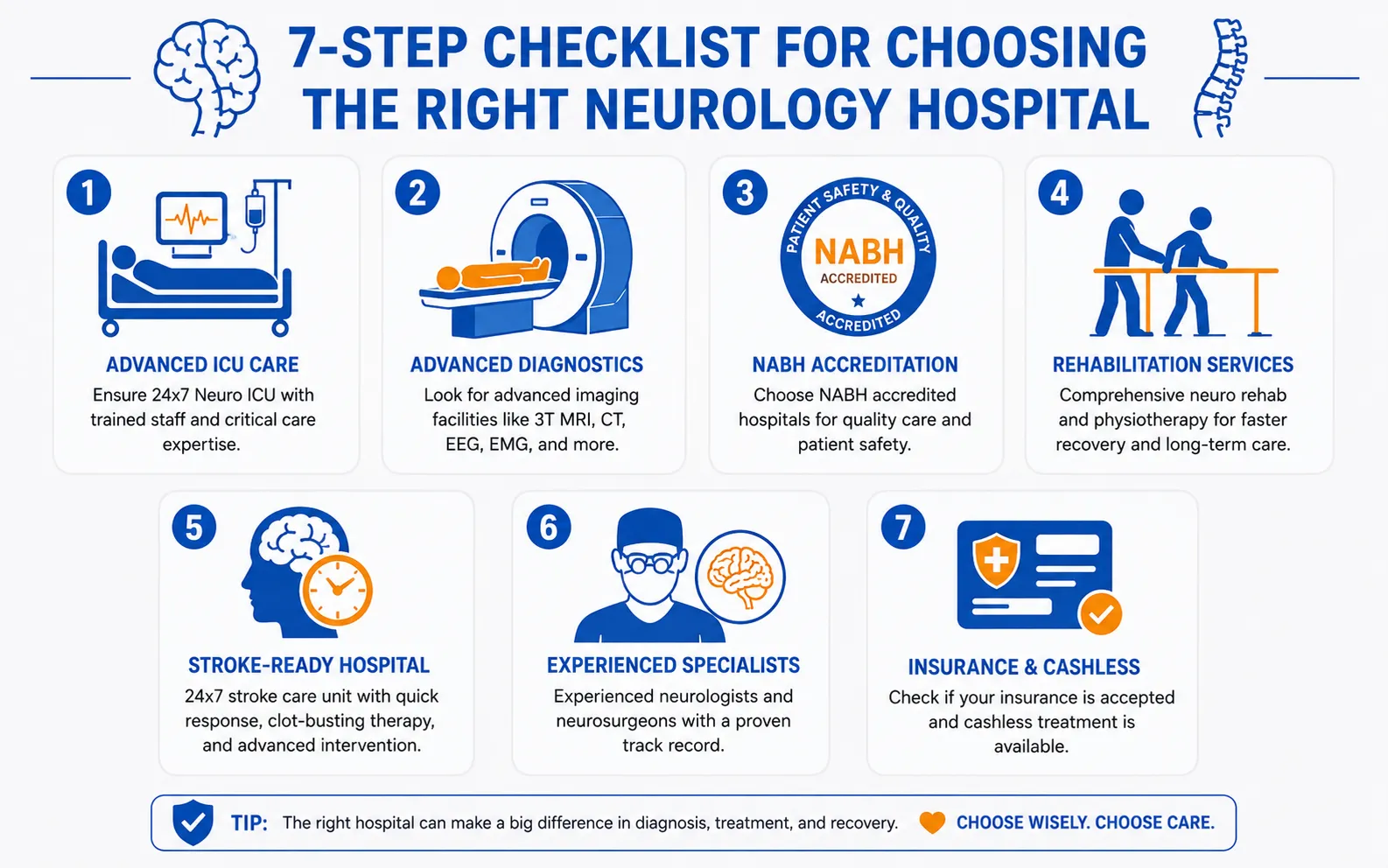
How to Choose the Best Neurology Hospital in India: 7 Key Criteria
1. Dedicated Neurology and Neurosurgery Departments
Look for hospitals where neurology and neurosurgery function as distinct, fully staffed departments — not as add-ons to a general medicine ward. The best centres maintain separate neurology and neurosurgery teams with 24×7 on-call cover.
2. A Dedicated Neuro ICU
Critically ill neurological patients — those with severe stroke, post-operative brain surgery, or status epilepticus — require a Neuro ICU staffed by intensivists trained in neurological monitoring. This is non-negotiable for complex cases. Apex Hospitals Jaipur operates a dedicated Neuro ICU as part of its broader ICU and critical care infrastructure, ensuring continuous neurological monitoring post-procedure.
3. Advanced Intraoperative Technology
Modern neurosurgery relies on neuro-navigation systems, intraoperative neuromonitoring, and high-precision operating microscopes. These technologies allow surgeons to operate closer to eloquent brain regions while reducing the risk of neurological deficits. Apex Hospitals is equipped with advanced operating microscopes, neuro-navigation systems, and intraoperative neuromonitoring — the same class of technology used in leading international neurosurgical centres.
4. Stroke-Ready Emergency Infrastructure
Stroke is a time-critical emergency. The National Institute of Neurological Disorders and Stroke (NINDS) emphasises that every minute of delayed treatment in ischaemic stroke results in the loss of approximately 1.9 million neurons. A hospital's stroke readiness — including 24×7 CT/MRI access, a thrombolysis protocol, and interventional capability — is therefore a life-or-death differentiator. Apex Hospitals Jaipur maintains on-site CT scan, MRI, and emergency labs available around the clock, alongside emergency OTs and a trained stroke response team.
5. Minimally Invasive Spine Surgery Capability
For patients with disc herniation, spinal stenosis, or vertebral fractures, minimally invasive spine surgery (MISS) offers significantly faster recovery, less blood loss, and lower infection risk compared to open surgery. Confirm that the hospital's neurosurgery team performs these procedures routinely — not occasionally.
6. Rehabilitation Integration
Recovery from stroke, brain surgery, or spinal cord injury is rarely complete without structured rehabilitation. Hospitals with in-house physiotherapy and rehabilitation units allow patients to begin recovery without the logistical burden of transferring to a separate facility.
7. NABH Accreditation
The National Accreditation Board for Hospitals & Healthcare Providers (NABH) sets India's highest benchmark for patient safety, clinical protocols, and quality management. NABH-accredited hospitals have demonstrated compliance with rigorous standards across all departments. Apex Hospitals is NABH accredited — a credential that matters especially for patients travelling from outside Rajasthan or from abroad.
Is Ayushman Bharat Available for Neurological Treatment?
Yes. Ayushman Bharat Pradhan Mantri Jan Arogya Yojana (PM-JAY) covers a wide range of neurological procedures including stroke management, brain surgery, spine surgery, and neurocritical care. Apex Hospitals is empanelled under Ayushman Bharat and major insurance and TPA schemes, meaning eligible patients can access these treatments with cashless or reimbursement benefits.
If you are unsure whether your condition or procedure is covered, the hospital's insurance desk can verify your eligibility before admission — removing financial uncertainty at an already stressful time.
Why Jaipur Is Emerging as a Hub for Neurology in Rajasthan
Jaipur has historically been underserved for super-specialty neurological care relative to Delhi or Mumbai. That gap has narrowed significantly over the past decade. The city now hosts hospitals with full neurology and neurosurgery departments, dedicated Neuro ICUs, and 24×7 emergency stroke protocols — making it a viable and often preferable alternative for patients from across Rajasthan, Madhya Pradesh, Haryana, and even parts of Gujarat.
For patients in smaller towns and districts, the HOPE Tele-ICU programme operated by Apex Hospitals represents a genuine breakthrough. This 24×7 remote ICU monitoring and consultation platform connects 18 partner sites across Rajasthan to Apex's command centre in Jaipur, delivering super-specialty neurological and critical care guidance to patients who would otherwise need to travel hundreds of kilometres. The programme has been featured in the Harvard Business Review and recognised at the GovConnect Conclave for HealthTech Excellence.
For those who do travel to Jaipur for treatment, Apex Hospitals Malviya Nagar — located at SP-4 & 6, Central Marg, Malviya Nagar Industrial Area — offers the full spectrum of neurological care under one roof, from emergency stroke response to elective spine surgery and post-operative rehabilitation.
What Treatments Are Available for Nervous System Diseases in India?
India's leading neurology hospitals now offer the full range of treatments available internationally. At Apex Hospitals Jaipur, the neurological treatment portfolio includes:
Stroke thrombolysis and mechanical thrombectomy — time-critical clot-busting and clot-retrieval procedures
Craniotomy and brain tumour resection — using advanced operating microscopes and neuro-navigation for maximal safe resection
Minimally invasive spine surgery — microdiscectomy, laminectomy, and spinal fusion with faster recovery
Epilepsy management — including video-EEG monitoring and surgical evaluation for drug-resistant cases
Peripheral nerve surgery — for conditions such as carpal tunnel syndrome and brachial plexus injuries
Neuro-oncology — in coordination with the oncology department for combined surgical and medical management of brain and spinal tumours
Neurological rehabilitation — structured physiotherapy, occupational therapy, and speech therapy post-stroke or post-surgery
Pain and intervention — for chronic neurological pain conditions, managed by the pain and intervention team
The hospital's NABH-accredited infrastructure — including on-site CT, MRI, and emergency labs — ensures that diagnostic workup and treatment can proceed without delays that might otherwise compromise outcomes in time-sensitive conditions like stroke.
The Role of Critical Care in Neurological Outcomes
One aspect of neurological treatment that patients often overlook when comparing hospitals is the quality of post-operative and post-stroke critical care. The Neuro ICU is where outcomes are often won or lost — particularly in the first 48–72 hours after a major neurological event or brain surgery.
Apex Hospitals operates a dedicated Neuro ICU alongside a broader advanced ICU and critical care infrastructure that includes ECMO capability — one of the most advanced life-support technologies available, with an 80% survival rate achieved at Apex in eligible cases. For neurological patients with concurrent cardiac or respiratory compromise, this integrated critical care capability can be decisive.
The hospital's ECMO programme is among the strongest in Rajasthan, reflecting the depth of critical care expertise available to all patients — including those admitted primarily for neurological conditions.
Frequently Asked Questions
What is the cost of neurological treatment in India?
Costs vary by condition and procedure. Stroke management typically ranges from ₹1.5 lakh to ₹4 lakh; brain tumour surgery from ₹2.5 lakh to ₹6 lakh; and minimally invasive spine surgery from ₹1.2 lakh to ₹3 lakh. These are indicative figures — your hospital should provide an itemised estimate before admission. Eligible patients can access significantly reduced costs under Ayushman Bharat.
Which city in India is best for brain surgery?
Delhi, Mumbai, and Chennai have historically been the primary destinations for brain surgery in India. However, Jaipur has emerged as a strong alternative — particularly for patients from Rajasthan and neighbouring states — with hospitals like Apex offering neurosurgical capability, Neuro ICU support, and advanced intraoperative technology at competitive costs with shorter travel distances.
Is Ayushman Bharat available for neurological treatment?
Yes. PM-JAY covers a broad range of neurological procedures including stroke management, brain surgery, and spine surgery. Apex Hospitals is empanelled under Ayushman Bharat, allowing eligible patients to access cashless treatment. Contact the hospital's insurance desk to verify your specific coverage before admission.
What treatments are available for nervous system diseases in India?
Indian neurology hospitals offer the full international spectrum: stroke thrombolysis and thrombectomy, brain tumour surgery, minimally invasive spine surgery, epilepsy surgery, peripheral nerve surgery, neuro-oncology, and structured neurological rehabilitation. The availability of specific treatments depends on the hospital — always confirm the procedure is performed routinely at your chosen centre.
How do I choose the best neurology hospital in India?
Prioritise hospitals with dedicated neurology and neurosurgery departments, a Neuro ICU, 24×7 emergency stroke capability, advanced intraoperative technology (neuro-navigation, operating microscopes), in-house rehabilitation, and NABH accreditation. Also confirm insurance empanelment and whether the hospital has experience with your specific condition.
References
Considering Neurological Treatment in Jaipur?
The team at Apex Hospitals Malviya Nagar is available to answer your questions, review your reports, and help you understand your treatment options — with no obligation.