
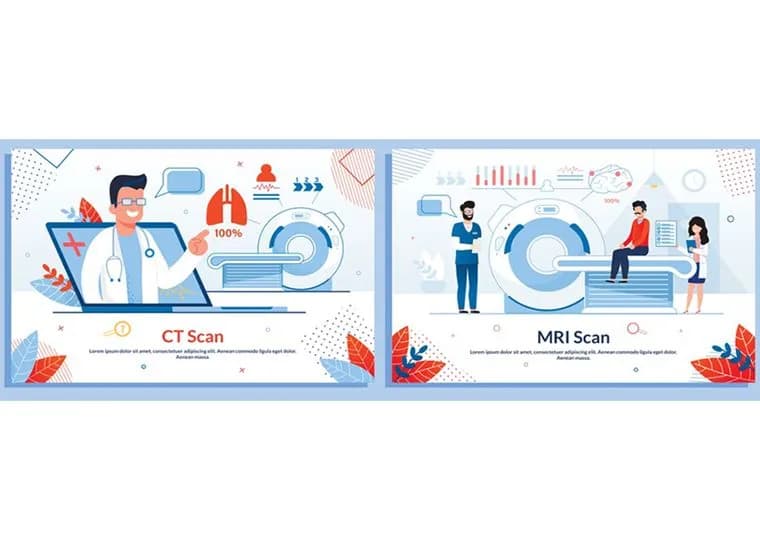
Imagine your doctor recommends an MRI or a CT scan, and you're left wondering: What’s the difference between the two? Which one is better for your condition? If you're feeling confused, you're not alone.
At Apex Hospitals, we often meet patients with these same questions. Both MRI (Magnetic Resonance Imaging) and CT (Computed Tomography) scans are powerful diagnostic tools, but they serve different purposes. While a CT scan is quick and excellent for detecting bone injuries or internal bleeding, an MRI offers detailed images of soft tissues, nerves, and organs.
In this blog, we’ll break down the key differences between MRI and CT scans, when each is recommended, and what to expect during the procedure. Whether you're preparing for a test or just curious, this guide will help you make an informed decision about your healthcare.
Magnetic Resonance Imaging (MRI) is a medical imaging technique that produces highly detailed cross-sectional images of the body’s internal structures. It uses a combination of strong magnetic fields, radio waves, and advanced computer technology to differentiate between healthy and abnormal tissues.
MRI is particularly valuable in cancer diagnosis, treatment planning, and staging. The high-resolution images can help radiologists detect and locate tumours, track how far cancer has spread, and assess whether it has metastasized to other parts of the body. Due to its superior ability to highlight soft tissues, MRI is often preferred over CT scans for examining the brain, spinal cord, muscles, ligaments, blood vessels, and even the interiors of bones.
There are also specialised MRI systems, such as functional MRI (fMRI), which monitor blood flow and brain activity, as well as open MRI machines, designed to help patients who may feel anxious or claustrophobic in standard MRI units.
A CT scan (Computed Tomography), sometimes also called a CAT scan (Computerized Axial Tomography), is an advanced imaging technique that combines multiple X-ray images taken from different angles to create detailed cross-sectional views of the body. Unlike traditional X-rays that capture a single image, a CT scanner rotates around the body, sending out several beams of radiation while the patient moves through the machine. A computer then processes this data to create 2D or 3D images of internal organs, bones, blood vessels, and soft tissues.
Each year, millions of CT scans are performed globally, making it one of the most commonly used diagnostic tools in modern medicine. It’s particularly useful for evaluating complex conditions that are not always visible with regular X-rays.
Doctors rely on CT scans for a wide range of diagnostic purposes, including
CT scans are fast, accurate, and non-invasive, making them an essential tool for diagnosis, treatment planning, and emergency care.
MRI (Magnetic Resonance Imaging) and CT (Computed Tomography) scans are two commonly used diagnostic imaging techniques that help doctors detect and evaluate various medical conditions. Although both are non-invasive and produce detailed images of the body’s internal structures, they work in different ways and serve different purposes.
Choosing between MRI and CT typically depends on the type of condition being evaluated, the area of the body involved, and the urgency of the diagnosis.
At Apex Hospital, we usually suggest an MRI in these cases:
Dr. Prithvi Giri Director and Head of Neuroscience Department, notes, “MRI helps us understand deeper structural issues, especially when X-rays and CT scans appear normal.”
CT scans are often advised for
Our radiology team at Apex Hospitals ensures the lowest possible radiation dose while delivering quick and accurate reports.
During an MRI or CT scan, the process is designed to be quick, safe, and non-invasive. In both tests, you’ll be asked to lie down on a flat table that slowly moves into a large, circular scanner. For a CT scan, the machine uses X-rays to take multiple cross-sectional images of your body in just a few minutes. It’s usually painless, and you may be asked to hold your breath briefly to get clearer images. In an MRI scan, powerful magnets and radio waves are used instead of radiation. The scan takes longer, typically 30 to 60 minutes, and you’ll hear loud tapping or thumping sounds during the test, for which earplugs or headphones are usually provided. In some cases, a contrast dye may be injected into a vein to highlight certain areas inside the body more clearly. Throughout the test, a radiology technician monitors you from a separate room, ensuring your safety and comfort.
If you experience:
...you may need advanced imaging. Apex Hospitals offers both MRI and CT scan services under one roof with expert radiologists and the latest machines.
Book your scan at Apex Hospital, Malviya Nagar, Jaipur


Download Our App


Powered By Docfyn



