

For someone living with kidney failure, every day revolves around dialysis. The hospital visits, the fatigue, the restrictions. A kidney transplant can change all of that, giving patients not just more time, but a better quality of life.
A kidney transplant is often the best long-term treatment for kidney failure. It is not just a procedure, for many patients, it is the difference between surviving and truly living again.
This guide explains what a kidney transplant involves, who needs one, what the procedure looks like, and what life looks like after. If you or someone you love is dealing with kidney disease, this is a good place to start.
The kidneys are two bean-shaped organs located on each side of the spine just below the rib cage. Each is about the size of a fist. Every day, they filter around 200 liters of blood, removing waste, balancing fluids, and regulating blood pressure, by producing urine.
When kidneys lose this filtering ability, harmful levels of fluid and waste collect in the body. This can raise blood pressure and result in kidney failure, also known as end-stage renal disease. End-stage renal disease means the kidneys have lost 90 % of their ability to function. The most common causes include:
· Diabetes — the leading cause of kidney failure in India
· High blood pressure (hypertension) — damages the blood vessels inside the kidneys over time
· Chronic kidney disease (CKD) that has progressed to an advanced stage
· Glomerulonephritis — inflammation of the kidney’s filtering units
· Polycystic kidney disease — a genetic condition where cysts grow inside the kidneys
Once kidney function drops below a critical threshold, the body can no longer manage on its own. At that point, a patient needs either dialysis or a kidney transplant to survive.
Many patients live on dialysis for years before a transplant becomes possible. Dialysis is a life-supporting treatment, it does the work the kidneys can no longer do. But it comes with significant limitations.
| The key difference: Dialysis manages kidney failure. A kidney transplant treats it. A successful transplant can restore near-normal kidney function and free patients from the dialysis routine entirely. |
Patients on dialysis typically need sessions three times a week, each lasting three to five hours. Over time, this affects energy levels, nutrition, work, and quality of life. A kidney transplant, when successful, removes this burden completely.
That said, a transplant is not suitable for everyone. The decision depends on the patient’s overall health, the availability of a suitable donor, and a thorough medical evaluation.
A kidney transplant is a surgical procedure in which a healthy kidney from a donor is placed into the body of a patient (recipient) whose kidneys have failed. The new kidney takes over the function of the damaged kidneys. Kidneys can be donated from living donors or from those who have died (deceased donors).
Not all kidney transplants are the same. At Apex Hospitals, the transplant team performs a full range of procedures depending on each patient’s condition:
ABO-Compatible Transplant — the standard transplant where donor and recipient have compatible blood groups
ABO-Incompatible Transplant — performed when blood groups do not match, using advanced desensitization protocols
HLA-Incompatible (High Immunological Risk) Transplant — for patients with antibodies that make finding a compatible donor difficult
Swap / Paired Exchange Transplant — when two donor-recipient pairs exchange kidneys because direct donation is not compatible between them. For example, if Donor A is compatible with Patient B but not Patient A, and Donor B is compatible with Patient A but not Patient B, the two pairs swap donors so both patients can receive a compatible kidney.
Cadaver (Deceased Donor) Transplant — a kidney donated by a person who has passed away, usually someone who was declared brain dead but whose organs remain viable. Cadaver transplants allow patients without a living donor to receive a kidney through the national organ donation registry.
Transplants for Highly Sensitized Patients — requiring specialised pre-treatment and immunological monitoring
Understanding what happens during a kidney transplant can help patients and families feel more prepared. Here is a simple overview of the process:
Before any transplant, the patient undergoes a thorough medical assessment. This includes blood tests, imaging studies, donor compatibility evaluation, and an overall health check. The goal is to ensure that both the donor and recipient are ready for a safe procedure.
A kidney donor is usually a family member, a parent, sibling, or spouse, who is willing to donate one of their kidneys. Living donor transplants generally have better outcomes than transplants from deceased donors. The donor also undergoes a detailed evaluation to confirm they are healthy enough to donate.
The transplant surgery itself typically takes three to four hours. The donor kidney is placed in the lower abdomen. The transplant surgeon connects the kidney’s blood vessels to the recipient’s blood vessels, and the ureter (the tube that carries urine) is attached to the bladder. Once the connections are made, blood flows into the new kidney, and in most cases, it begins working almost immediately.
After surgery, the patient is monitored closely in the transplant ICU. The body’s immune system may recognise the new kidney as foreign and try to reject it, which is why patients are prescribed immunosuppressive medications that they will take long-term.
Regular follow-up appointments are essential to monitor kidney function, adjust medications, and catch any complications early.
A kidney donor is typically a close family member who has been medically and legally evaluated and approved. In India, living related donation, from a blood relative, is the most common form of kidney donation.
The donor must be in good overall health, have two functioning kidneys, and be willing to donate without any coercion. The evaluation process ensures the donor’s safety is protected at every stage.
In some cases, swap or paired exchange transplants make donation possible even when a family member’s kidney is not directly compatible.
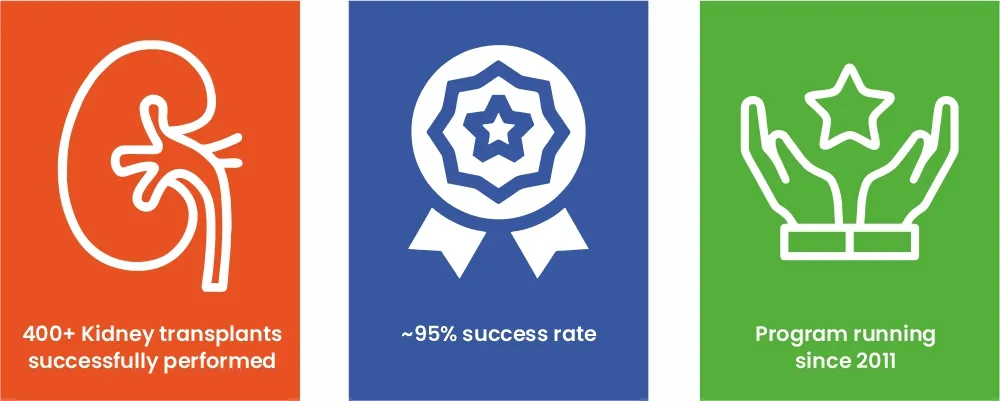
The kidney transplant program at Apex Hospitals began in 2011. Over the years, it has grown into one of the most trusted transplant programs in Rajasthan, not just because of the numbers, but because of the outcomes.
· 400+ kidney transplants successfully performed
· ~95% success rate
· Low infection rate maintained through strict medical protocols
· Dedicated transplant coordinator support for every patient
· Complete pre and post-transplant care under one roof
One milestone that stands out: in 2015, the team successfully performed a kidney transplant on an 8-year-old child, one of the youngest transplant recipients treated at the center. It is the kind of case that reflects what the program is built for.
| Infrastructure: Modern modular operation theatres | Dedicated transplant ICU | In-house diagnostics & laboratory | Strict infection control protocols |
Considering a kidney transplant?
Talk to our transplant specialists. We’ll guide you through every step.
Medically reviewed by:
Dr. Ajay Pal Singh
Director- Nephrology & Renal Transplant
MBBS, MD - Internal Medicine, DM - Nephrology
Frequently Asked Questions
The cost varies depending on the patient’s condition, the type of transplant required, and eligibility under insurance or government schemes. Speak to our transplant coordinator for a personalized estimate.
Yes. Kidney transplant treatment at Apex Hospitals is available under RGHS, CGHS, Chiranjeevi Yojana, ECHS, Ayushman Bharat (eligibility based), and all major insurance TPAs with cashless facility.
In most cases, a successful kidney transplant eliminates the need for dialysis. The new kidney takes over the function of the failed kidneys. However, this depends on how well the transplanted kidney functions after surgery.
Most patients are hospitalised for 7–10 days after the procedure. Full recovery, including a return to normal activity, typically takes 4–6 months. Regular follow-up appointments are essential throughout this period.
Apex Hospitals maintains a success rate of approximately 95% for kidney transplant procedures, supported by strict clinical protocols and comprehensive post-transplant care.
Yes. Apex Hospitals has successfully performed kidney transplants on paediatric patients, including an 8-year-old child in 2015. Each case is evaluated individually by the transplant team.