
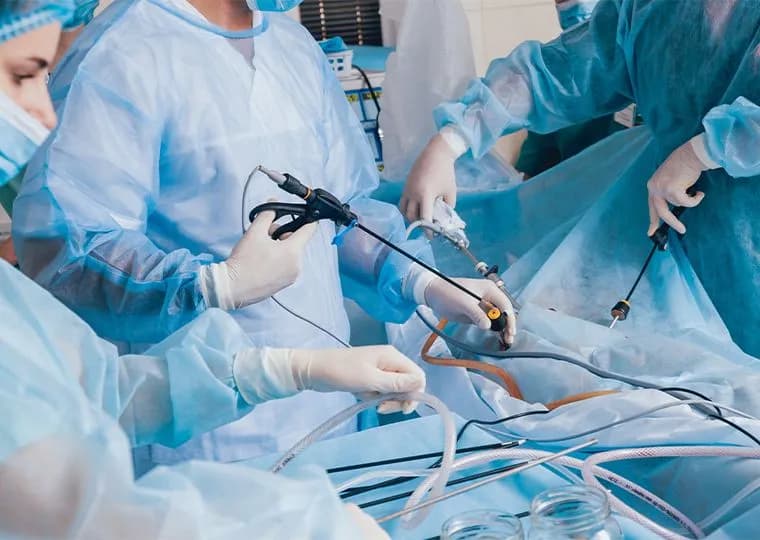
Imagine needing surgery and worrying about long hospital stays, painful scars, and weeks of rest before getting back to normal life. For many patients, this fear often delays their treatment. But today, with laparoscopic surgery, recovery is faster, scars are smaller, and hospital stays are shorter. At Apex Hospitals, our expert surgical team uses advanced laparoscopic techniques to ensure patients heal quickly and return to their daily routines with confidence.
In this blog, we’ll explain what laparoscopic surgery is, how it reduces recovery time, its benefits, and when you should consult a doctor.
Laparoscopic surgery is a minimally invasive surgical technique that allows doctors to look inside the abdomen or pelvic region without making large cuts. Instead of a long incision, surgeons use a thin instrument called a laparoscope, a slender tube with a high-resolution camera attached at its tip. This camera projects real-time images of the internal organs onto a monitor, giving surgeons a clear and detailed view while they perform the procedure.
During laparoscopy, one or more very small incisions (usually less than a centimetre) are made in the abdomen. Through these, the laparoscope and other fine surgical instruments are inserted. This approach lets surgeons examine organs, take biopsies (tissue samples), or even carry out complex procedures, all with minimal disturbance to surrounding tissues.
Because the cuts are so small, laparoscopy is often referred to as “keyhole surgery.” Compared to traditional open surgery, it causes less trauma, reduces the risk of infection, and leads to much faster recovery. Most patients experience shorter hospital stays, less pain after surgery, and quicker return to daily activities.
Laparoscopy isn’t limited to just diagnosis; it is widely used for many surgical treatments. Some of the most common procedures include:
Here’s how it speeds up healing compared to traditional surgery:
When comparing laparoscopic surgery with traditional open surgery, the differences are quite clear. In laparoscopic surgery, only tiny cuts about 0.5–1 cm are made, while open surgery requires a much larger incision, usually around 5–10 cm. Because of these smaller cuts, patients undergoing laparoscopic procedures generally stay in the hospital for just 1–2 days, whereas open surgery may require 5–7 days of hospitalization. Recovery is also much faster; most people bounce back within 7–10 days after laparoscopic surgery, compared to 4–6 weeks with open surgery. Another big advantage is scarring; laparoscopic surgery leaves only minimal, barely noticeable marks, while open surgery often results in visible scars. Lastly, the risk of infection is significantly lower in laparoscopic surgery, making it a safer and more comfortable option for many patients.
At Apex Hospitals, we follow a step-by-step approach to ensure laparoscopic surgery is safe and effective:
While quicker recovery is one of the biggest advantages of laparoscopic surgery, patients also experience many other benefits that make this approach a preferred choice today:
Recovery doesn’t end when you leave the hospital. Here are some tips for healing faster:
If you experience severe abdominal pain, fever, excessive swelling, or bleeding from the incision site after laparoscopic surgery, contact your surgeon immediately. Don’t let fear of a long recovery stop you from getting the treatment you need. At Apex Hospital, Jaipur, our laparoscopic specialists ensure safe, precise, and faster-healing surgeries with minimal downtime.


Download Our App


Powered By Docfyn