
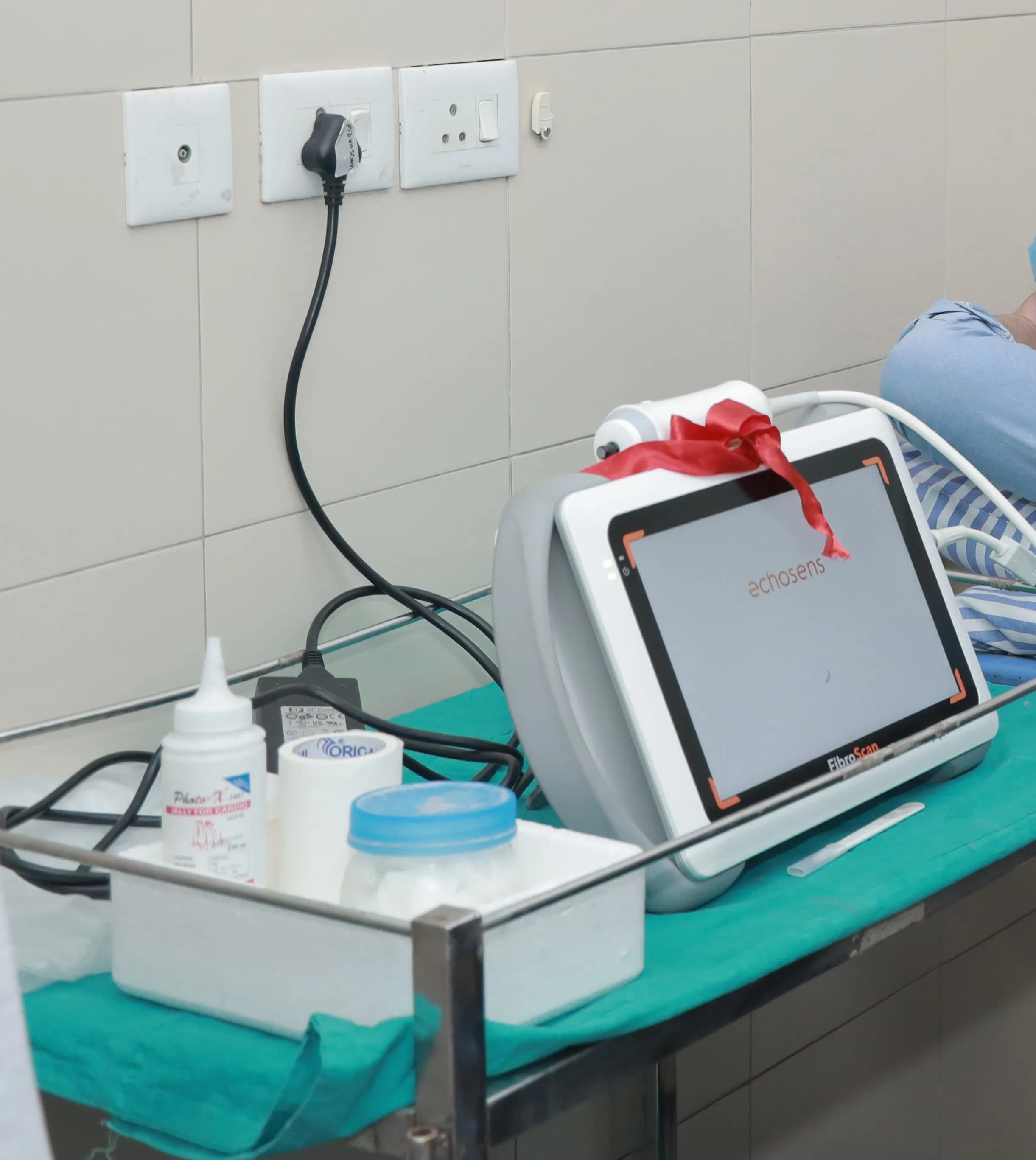
Your doctor has recommended a Fibroscan. Or maybe you have been managing fatty liver for a while and want to understand what this test really tells you. Either way, you are in the right place.
Fibroscan is a painless, non-invasive test that gives doctors a clear picture of your liver health, specifically how much scarring or fat has built up inside it. It takes about 10 minutes, requires no needles, no sedation, and no hospital stay.
In this guide, we explain what Fibroscan is, how it works, what conditions it helps detect, and how to understand your results.
Fibroscan is a specialized medical device that uses a technology called transient elastography to assess two key things about your liver:
• Liver stiffness — which indicates how much fibrosis (scarring) is present
• Fat content in the liver — measured through what is called the CAP score
Think of it like an ultrasound, but with a difference. Instead of just producing an image, Fibroscan sends a small, gentle vibration into the liver and measures how quickly it travels through the tissue.
A healthy liver is soft. A scarred or fatty liver is stiffer. The speed at which the vibration travels reveals how much damage, if any, is present, and the device converts this into a score your doctor can interpret.
| In simple words: Fibroscan is a health check for your liver; done from the outside, in minutes, with no discomfort. |
The liver quietly does hundreds of jobs every day, filtering toxins, processing nutrients, producing bile, managing blood sugar, and more. It rarely complains, even when things start going wrong.
When the liver is repeatedly damaged, by excess fat, alcohol, viral infections like hepatitis, or metabolic conditions — it begins to scar. This scarring is called fibrosis. Over time, advanced fibrosis becomes cirrhosis, where so much of the liver is scarred that it can no longer function properly.
Here is the difficult part: liver disease is largely silent. Most people have no symptoms until significant damage has already occurred. That is exactly why a test like Fibroscan is so valuable, it can catch problems early, when there is still time to act.
A gastroenterologist may recommend Fibroscan if you have any of the following:
• Fatty liver disease (NAFLD or NASH)
• Chronic hepatitis B or hepatitis C
• A history of regular alcohol consumption
• Elevated liver enzymes (ALT, AST) on a routine blood test
• Diabetes, obesity, or metabolic syndrome
• Long-term use of medications that can affect the liver
• A family history of liver disease or cirrhosis
It is also commonly used to monitor patients already diagnosed with liver disease — tracking whether their condition is improving, stable, or worsening over time.
“Many patients with significant liver fibrosis have no symptoms at all. Fibroscan allows us to identify liver damage early and intervene before it becomes irreversible.” — Dr. Ashok Kumar Dudhwal, Consultant – Gastroenterology (DM – AIIMS Delhi), Apex Hospitals, Malviya Nagar, Jaipur |
The procedure is simple and takes around 10 to 15 minutes. Here is what to expect:
• You lie on your back with your right arm raised behind your head.
• A small probe is placed on the skin over the right side of your abdomen, where the liver is.
• The probe sends a gentle, painless vibration into the liver. Most patients describe it as a mild tapping sensation; nothing more.
• The device measures how quickly the vibration passes through the liver tissue and calculates a stiffness score.
• At the same time, the CAP score is recorded to measure fat content.
• Results appear on the screen right away.
No injections. No sedation. No recovery time. Most patients are done and on their way within 20 minutes.
| Before your Fibroscan: You will usually be asked to fast for at least 2 hours beforehand. Avoid heavy exercise the day before, as this can temporarily affect liver stiffness readings. |
Your results come in two parts. Here is what each one means:
This tells your doctor how much fibrosis is present. The higher the number, the stiffer the liver — and the more scarring there is.
| Stiffness Score (kPa) | What It Means |
| Less than 7 kPa | Normal liver — no significant fibrosis |
| 7 – 9.5 kPa | Mild to moderate fibrosis |
| 9.5 – 12.5 kPa | Significant fibrosis |
| 12.5 – 14.5 kPa | Severe fibrosis |
| Above 14.5 kPa | Cirrhosis likely |
These are general reference ranges. Your doctor will always interpret your score alongside your blood tests, symptoms, and medical history, not in isolation.
This measures how much fat is in the liver, particularly relevant for patients with fatty liver disease.
• Below 238 dB/m — Normal
• 238 – 259 dB/m — Mild fatty liver
• 260 – 290 dB/m — Moderate fatty liver
• Above 290 dB/m — Severe fatty liver
| Good to know: A high CAP score alone does not mean serious disease. Your doctor will look at both scores together, along with your full clinical picture, before recommending next steps. |
For a long time, liver biopsy was the only reliable way to stage liver fibrosis, a needle inserted through the skin to extract a small tissue sample for examination under a microscope. It is still considered the gold standard for certain diagnoses, but it comes with real drawbacks.
Fibroscan has changed the way liver health is assessed. Here is a direct comparison:
| Feature | Fibroscan | Liver Biopsy |
| Procedure type | Non-invasive | Invasive (needle) |
| Pain | None | Mild to moderate |
| Complications | None | Bleeding, infection |
| Time taken | 10–15 minutes | 30–60 min + recovery |
| Hospitalization | Not required | Usually required |
| Repeatability | Can be done regularly | Limited due to risk |
| Cost | More affordable | Higher |
For most patients, Fibroscan is now the preferred first step. Liver biopsy is reserved for cases where Fibroscan results are inconclusive, or when a tissue sample is specifically needed.
“Fibroscan has transformed how we evaluate liver health. It gives us reliable, reproducible results without putting the patient through an invasive procedure, and we can track changes over time with repeat tests.” — Dr. Mohammad Rehan, Consultant – Gastroenterology, Apex Hospitals, Malviya Nagar Jaipur |
Fatty liver disease is increasingly common, driven by rising rates of obesity, diabetes, and sedentary lifestyles. Fibroscan can measure both the fat content in the liver and any associated scarring — giving doctors the information they need to decide whether lifestyle changes are enough, or whether closer monitoring and treatment are required.
Chronic viral hepatitis causes slow, progressive liver damage over years. Fibroscan helps stage the degree of fibrosis so doctors can determine when to start treatment and assess how the liver is responding to antiviral therapy.
Long-term alcohol use damages liver cells over time. Fibroscan gives a clear picture of how much scarring has occurred, helping doctors guide treatment and giving patients a tangible reason to make changes.
For patients already living with a liver condition, Fibroscan offers a simple, repeatable way to track disease progression or improvement — without the risks associated with repeated biopsies.
Fibroscan is highly accurate in most patients, but it does have some limitations:
• Results can be less reliable in patients with a high BMI or significant abdominal obesity, though newer probe types have improved this
• Recent food, vigorous exercise, or active liver inflammation can temporarily elevate readings
• It assesses a region of the liver, not the entire organ, so very localised disease may not always be captured
• It cannot identify the cause of liver disease on its own, blood tests and other investigations are usually needed alongside it
Despite these limitations, Fibroscan remains one of the most useful and widely used tools in modern liver care.
You do not need to wait for symptoms to get your liver checked. Speak to a gastroenterologist if you:
• Have been told you have a fatty liver on an ultrasound
• Have diabetes, obesity, or metabolic syndrome
• Drink alcohol regularly
• Have chronic hepatitis B or C
• Have persistently elevated liver enzymes on blood tests
• Have a family history of liver disease or cirrhosis
Catching liver disease early gives you the best chance of stopping or reversing the damage before it reaches an irreversible stage.
Fibroscan is available at Apex Hospitals, Malviya Nagar, Jaipur, performed and interpreted by our experienced gastroenterology team.
Dr. Mohammad Rehan – Consultant, Gastroenterology | MBBS, DNB General Medicine, DrNB Gastroenterology
Dr. Ashok Kumar Dudhwal – Consultant, Gastroenterology | MBBS, MD Medicine, DM Gastroenterology & Hepatology (AIIMS Delhi)
Both doctors bring deep, specialised expertise in liver disease, hepatitis management, and advanced gastroenterology — ensuring your results are interpreted in the full context of your health, not just as a number on a screen.
Concerned about your liver health?
A Fibroscan takes just 10 minutes and could give you the answers you need.
Book a consultation at Apex Hospitals, Jaipur
Medically Reviewed By
Dr. Mohammad Rehan
Consultant – Gastroenterology | MBBS, DNB General Medicine, DrNB Gastroenterology | Apex Hospitals, Jaipur
Dr. Ashok Kumar Dudhwal
Consultant – Gastroenterology | MBBS, MD Medicine, DM – AIIMS Delhi | Apex Hospitals, Jaipur
No. It is completely painless. You may feel a very light tapping where the probe is placed, but most patients barely notice it.
The scan itself takes about 10 minutes. With preparation and a brief consultation, most patients are done within 20 to 30 minutes.
In most cases, yes — a 2-hour fast is recommended. Your doctor or the booking team will give you specific instructions beforehand.
This depends entirely on your condition. Patients with chronic liver disease may be advised to repeat it every 1–2 years. Your gastroenterologist will advise based on your individual situation.
No — Fibroscan is not designed to detect cancer. It measures fibrosis and fat content. If liver cancer is suspected, your doctor will order additional imaging such as an ultrasound, CT, or MRI.
In many cases, yes — especially when caught early. With appropriate treatment, lifestyle changes such as weight loss and reduced alcohol, and regular follow-up, fibrosis can stabilise or even reverse. This is why early detection through Fibroscan matters so much.

Download Our App


Powered By Docfyn