
India carries one of the world's largest burdens of neurological disease — understanding the risks, warning signs, and where to find specialist care can make a life-changing difference.
By Apex Hospitals · Published 14th August, 2026
Neurological disorders, conditions affecting the brain, spinal cord, and peripheral nerves, represent a growing public health challenge across India. According to the World Health Organization, neurological conditions affect over 1 in 3 people globally, making them the leading cause of illness and disability.
A landmark study published in The Lancet Global Health estimated that India has approximately 30 million people living with epilepsy, over 1.8 million new stroke cases annually, and tens of millions more affected by conditions such as migraine, Parkinson's disease, dementia, and peripheral neuropathy. Despite these numbers, neurological care remains under-resourced in many parts of the country, including Rajasthan, making access to a qualified neurology specialist critically important for patients and families across the region.
At Apex Hospitals, Malviya Nagar, Jaipur, our neurology and neurosurgery teams have collectively managed over 12,000 neurological patients, offering diagnosis, medical management, and surgical intervention under one NABH-accredited roof.
While the full spectrum of neurological disease is broad, the following conditions account for the majority of cases seen in Indian hospitals and clinics:
Stroke is the single largest cause of neurological disability in India. It occurs when blood supply to part of the brain is interrupted — either by a clot (ischaemic stroke) or a burst blood vessel (haemorrhagic stroke). India sees an estimated 1.8 million new strokes per year, with a mortality rate significantly higher than in high-income countries, largely due to delays in reaching specialist care. Hypertension, diabetes, smoking, and atrial fibrillation are the dominant risk factors in the Indian population. Time-critical intervention, ideally within the first 4.5 hours, also known as the golden hour is essential for ischaemic stroke, making proximity to a well-equipped emergency and trauma centre in Jaipur a potential life-saver.
India is home to an estimated 10–12 million people with epilepsy, roughly one-sixth of the global epilepsy burden. Despite being highly treatable with anti-epileptic drugs, a significant proportion of patients in rural Rajasthan and other underserved areas remain undiagnosed or inadequately managed. Stigma, limited access to neurologists, and poor medication adherence all contribute to the treatment gap. Early diagnosis and consistent medical management can allow the vast majority of people with epilepsy to live seizure-free lives.
Migraine is one of the most prevalent yet under-diagnosed neurological conditions in India, affecting an estimated 150 million people. It disproportionately affects women of working age and is a leading cause of lost productivity. Many patients self-medicate with over-the-counter analgesics, which can paradoxically worsen headaches over time (medication-overuse headache). A neurologist can distinguish migraine from tension-type headache, cluster headache, and secondary headaches caused by structural brain disease, and tailor a preventive treatment plan accordingly.
Parkinson's disease is the second most common neurodegenerative disorder worldwide, and India's ageing population is driving a steady rise in prevalence. Characterised by tremor, rigidity, slowness of movement, and postural instability, Parkinson's is often misdiagnosed as normal ageing in its early stages. While there is currently no cure, modern pharmacological therapy and physiotherapy can substantially improve quality of life. Our physiotherapy and rehabilitation team at Apex Hospitals works alongside neurologists to provide integrated Parkinson's care.
India currently has an estimated 5.3 million people living with dementia, a figure projected to more than double by 2050 as the population ages. Alzheimer's disease accounts for 60–70% of dementia cases. Memory loss, confusion, personality changes, and difficulty with daily tasks are hallmark features. Early specialist assessment is vital, not only to confirm the diagnosis but to rule out treatable causes of cognitive decline such as hypothyroidism, vitamin B12 deficiency, and normal-pressure hydrocephalus.
Given India's enormous diabetes burden, with over 77 million people living with type 2 diabetes, diabetic peripheral neuropathy is extremely common. Patients experience numbness, tingling, burning pain, or weakness in the hands and feet. Left unmanaged, neuropathy increases the risk of foot ulcers and amputation. Tight glycaemic control, combined with specialist neurological assessment, is the cornerstone of management.
Brain tumours, both primary (originating in the brain) and secondary (metastatic from other cancers), present with headaches, seizures, personality changes, or focal neurological deficits depending on their location. India reports approximately 28,000 new brain tumour cases annually. Accurate diagnosis requires advanced imaging, and treatment may involve surgery, radiation, chemotherapy, or a combination. Apex Hospitals' neurosurgery department in Jaipur is equipped with advanced operating microscopes and neuro-navigation systems for complex brain and spine procedures.
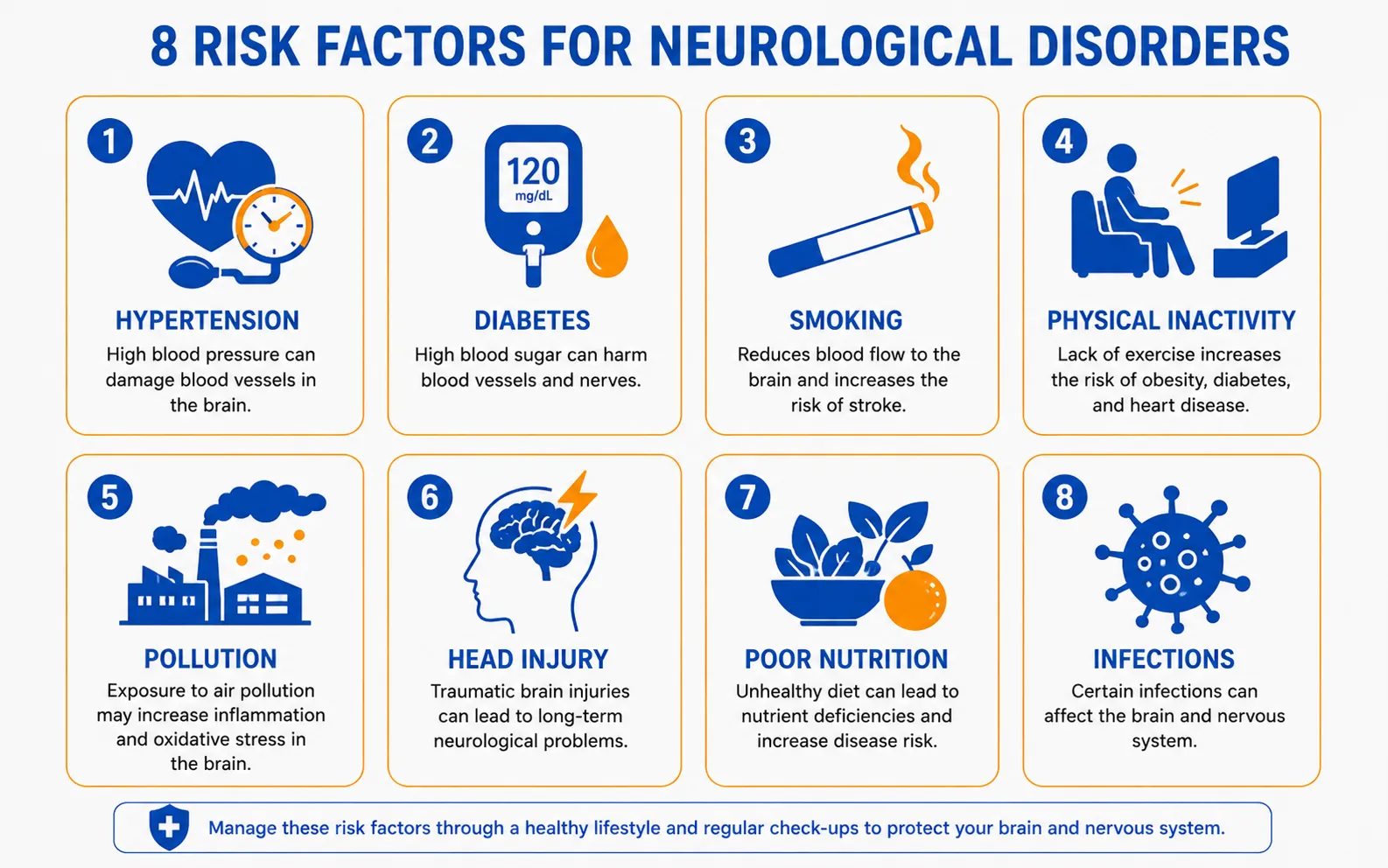
While some neurological conditions have a genetic basis, the majority are strongly influenced by modifiable lifestyle and environmental factors. Understanding these risks is the first step toward prevention:
Hypertension: The single most important modifiable risk factor for stroke. India has an estimated 220 million hypertensive adults, many of whom are undiagnosed or inadequately treated.
Diabetes mellitus: Increases the risk of stroke, peripheral neuropathy, and cognitive decline. India is the world's second-largest diabetes nation.
Tobacco use: Smoking doubles the risk of ischaemic stroke and is associated with accelerated cognitive decline.
Physical inactivity: Sedentary behaviour is linked to higher rates of stroke, dementia, and depression-related neurological symptoms.
Air pollution: Emerging evidence links chronic exposure to fine particulate matter (PM2.5), a significant problem in Rajasthan's urban centres, with increased risk of stroke and neurodegenerative disease.
Head injury: Traumatic brain injury (TBI) is a major cause of neurological disability in India, driven largely by road traffic accidents. Rajasthan's high road accident rate makes TBI a particular concern in the state.
Nutritional deficiencies: Vitamin B12 and folate deficiency, common in vegetarian-predominant diets, can cause peripheral neuropathy and cognitive impairment.
Infections: Neurocysticercosis (tapeworm infection of the brain) remains a significant cause of new-onset epilepsy in rural India.
Many of these risk factors are preventable or manageable with the right medical support. Our internal medicine specialists at Apex Hospitals work with patients to address cardiovascular and metabolic risk factors before neurological complications arise.
Neurological emergencies can develop rapidly. The following symptoms warrant immediate medical attention:
Sudden severe headache — often described as "the worst headache of my life"
Sudden weakness or numbness on one side of the face, arm, or leg
Sudden difficulty speaking, understanding speech, or finding words
Sudden loss of vision in one or both eyes
Loss of consciousness, seizure, or convulsion
Sudden dizziness, loss of balance, or difficulty walking
Progressive memory loss or personality change
Persistent tremor, stiffness, or slowness of movement
If you or a family member experiences any of these symptoms, do not wait. Apex Hospitals operates a 24×7 emergency department with on-site CT scan, MRI, and emergency laboratory services, ensuring that time-critical neurological conditions such as stroke receive immediate attention.
Rajasthan presents a unique challenge in neurological care. The state's large rural population, combined with a historically limited number of neurologists per capita, has meant that many patients travel long distances, or go untreated, when neurological symptoms arise. Urban centres like Jaipur therefore carry a disproportionate responsibility for providing high-quality neurological care not just to city residents but to patients from across the state.
Apex Hospitals has addressed this gap through two complementary approaches. First, our Jaipur facility at Malviya Nagar provides comprehensive in-person neurological and neurosurgical care, backed by advanced imaging (CT, MRI), a dedicated Neuro ICU, and experienced specialists. Second, our HOPE Tele-ICU Command Centre, featured in the Harvard Business Review and recognised at the GovConnect Conclave for HealthTech Excellence, connects 18 partner sites across Rajasthan to super-specialty ICU expertise remotely, reducing the cost burden on critically ill patients by ₹40,000–₹50,000 per day.
For patients seeking the best neurology hospital in Jaipur, Apex Hospitals combines clinical depth, advanced technology, and a patient-centred approach that is rare in the region.
Modern neurology relies on a combination of clinical assessment and advanced diagnostics to reach an accurate diagnosis. At Apex Hospitals, the diagnostic pathway typically includes:
Detailed neurological examination — assessing cognition, cranial nerves, motor and sensory function, reflexes, and coordination
MRI and CT brain/spine imaging — available on-site with rapid reporting
Electroencephalography (EEG) — for epilepsy diagnosis and characterisation
Nerve conduction studies and electromyography (EMG) — for peripheral nerve and muscle disorders
Lumbar puncture (spinal tap) — when infection, inflammation, or subarachnoid haemorrhage is suspected
Blood and CSF biomarker testing — supported by our on-site pathology laboratory
Treatment is tailored to the individual condition and may include pharmacological therapy, surgical intervention via our neurosurgery team in Jaipur, structured rehabilitation through our physiotherapy and rehabilitation unit, and long-term follow-up for chronic conditions such as epilepsy, Parkinson's, and dementia.
For patients with neurological conditions complicated by psychiatric symptoms, such as depression in Parkinson's disease or anxiety in epilepsy, our integrated psychiatry department provides co-managed care within the same facility.
While not all neurological diseases are preventable, a substantial proportion of the burden, particularly stroke, diabetic neuropathy, and cognitive decline, can be reduced through proactive lifestyle choices and regular health monitoring:
Keep blood pressure below 130/80 mmHg through diet, exercise, and medication if prescribed
Maintain healthy blood sugar levels and get screened for diabetes regularly
Quit smoking — the risk of stroke begins to fall within weeks of stopping
Exercise for at least 150 minutes per week at moderate intensity
Eat a diet rich in vegetables, whole grains, and omega-3 fatty acids; limit processed foods and salt
Wear helmets on two-wheelers and seatbelts in cars to prevent traumatic brain injury
Get regular health check-ups, especially if you have a family history of stroke or dementia
Ensure adequate vitamin B12 intake — particularly important for vegetarians
Our dietetics and nutrition specialists at Apex Hospitals can help you build a brain-healthy eating plan tailored to your individual needs and risk profile.
The most prevalent neurological conditions in India include stroke, epilepsy, migraine, Parkinson's disease, dementia (including Alzheimer's disease), peripheral neuropathy (often linked to diabetes), and brain tumours. Together, these conditions affect hundreds of millions of Indians and represent a major cause of disability and premature death.
Estimates vary by condition, but collectively neurological disorders affect well over 100 million people in India when migraine, epilepsy, stroke survivors, neuropathy, and neurodegenerative diseases are counted together. India carries approximately one-sixth of the global epilepsy burden alone, and sees nearly 1.8 million new strokes every year.
Stroke is widely considered the leading cause of neurological disability in India, accounting for the greatest number of disability-adjusted life years (DALYs) lost. Migraine, however, is the most prevalent neurological condition by sheer number of people affected.
Yes. Apex Hospitals in Malviya Nagar, Jaipur is a NABH-accredited multi-specialty hospital with a dedicated neurology and neurosurgery department. With over 12,000 neurological patients treated, on-site MRI and CT imaging, a dedicated Neuro ICU, and a team of experienced neurologists and neurosurgeons, it is among the most comprehensively equipped neurological care centres in Rajasthan.
The most significant modifiable risk factors include uncontrolled hypertension, poorly managed diabetes, tobacco use, physical inactivity, obesity, excessive alcohol consumption, and chronic exposure to air pollution. Head injuries from road accidents are also a major preventable cause of neurological disability in India. Addressing these factors through lifestyle change and regular medical monitoring can substantially reduce individual risk.
You should seek a neurological consultation if you experience recurring headaches that are severe or changing in character, unexplained memory problems, seizures, persistent dizziness or balance problems, weakness or numbness in the limbs, tremor, or any sudden neurological symptom. For sudden-onset symptoms such as facial drooping, arm weakness, or speech difficulty, call emergency services immediately — these may indicate a stroke.
Our neurology team at Apex Hospitals Jaipur is here to help — with expert diagnosis, advanced imaging, and compassionate care for every patient.