
A clinically grounded guide for patients and families navigating neurological and spinal conditions — with insights from Apex Hospitals, Jaipur's NABH-accredited neuroscience centre.
By the Apex Hospitals Medical Editorial Team · Published July 2026
The brain and spinal cord together form the central nervous system — the command centre that governs every thought, movement, sensation, and organ function in the human body. When something goes wrong in this system, the consequences can range from a nagging backache to a life-altering stroke or tumour. Yet many patients delay seeking help because they mistake early warning signs for fatigue, ageing, or stress.
According to the World Health Organization, neurological disorders affect more than one billion people globally and are a leading cause of disability and death. In India, the burden is compounded by limited awareness, late diagnosis, and uneven access to specialist care — particularly in Tier-2 cities and rural Rajasthan.
This article explains the most common causes of brain and spine problems, the symptoms you should never ignore, and the treatment pathways available today — including advanced surgical options now accessible right here in Jaipur at Apex Hospitals' Neurosurgery department.
Brain disorders arise from a wide spectrum of causes — some sudden and traumatic, others slow and degenerative. Understanding the root cause is the first step toward effective treatment.
A stroke occurs when blood supply to part of the brain is interrupted — either by a clot (ischaemic stroke) or a ruptured blood vessel (haemorrhagic stroke). Stroke is the second leading cause of death worldwide and one of the most common neurological emergencies seen at Indian hospitals. High blood pressure, diabetes, smoking, and atrial fibrillation are the dominant risk factors.
Brain tumours — both primary (originating in the brain) and secondary (metastatic, spreading from elsewhere in the body) — can compress vital structures and cause headaches, seizures, vision changes, or personality shifts. Gliomas, meningiomas, and pituitary adenomas are among the most frequently diagnosed types. Early imaging and biopsy are critical for accurate grading and treatment planning. Patients searching for brain tumour treatment in Jaipur should seek centres with dedicated neuro-oncology pathways and intraoperative navigation systems.
Bacterial meningitis, viral encephalitis, and tuberculosis of the brain remain significant causes of neurological morbidity in India. These conditions can progress rapidly and require urgent hospitalisation, lumbar puncture for diagnosis, and targeted antimicrobial therapy.
Epilepsy affects approximately 50 million people worldwide, with India accounting for nearly 10–12 million cases, as reported by the World Health Organization. Seizures can be caused by genetic factors, brain injury, stroke, tumours, or infections. Many patients achieve good seizure control with medication; a subset may benefit from surgical intervention.
Conditions such as Parkinson's disease, Alzheimer's disease, and amyotrophic lateral sclerosis (ALS) involve the progressive loss of nerve cells. While these cannot yet be cured, early diagnosis and specialist management through neurology services in Jaipur can significantly slow progression and improve quality of life.
Road traffic accidents are a leading cause of traumatic brain injury (TBI) in India. TBI can range from mild concussion to severe diffuse axonal injury requiring emergency neurosurgical intervention. Rapid access to a trauma-equipped neurosurgery centre is the single most important determinant of outcome.
The spine is a complex structure of vertebrae, discs, ligaments, and the spinal cord itself. Problems can arise at any level — cervical (neck), thoracic (mid-back), or lumbar (lower back) — and from a variety of causes.
The intervertebral discs act as shock absorbers between vertebrae. With age or repetitive strain, these discs can dehydrate, bulge, or rupture — pressing on nearby nerve roots and causing pain, numbness, or weakness that radiates into the arms or legs (radiculopathy). This is one of the most common reasons patients visit a spine specialist.
Narrowing of the spinal canal — often due to bone spurs, thickened ligaments, or disc bulges — compresses the spinal cord or nerve roots. Patients typically report pain and cramping in the legs when walking (neurogenic claudication) that is relieved by sitting or bending forward.
Both primary spinal tumours and metastatic deposits from cancers of the lung, breast, or prostate can erode vertebrae and compress the cord. Spinal tuberculosis (Pott's disease) remains prevalent in India and can cause vertebral collapse and paraplegia if untreated. The oncology team at Apex Hospitals works in close coordination with neurosurgeons for spinal metastasis cases.
Falls, road accidents, and sports injuries can fracture or dislocate vertebrae, directly injuring the spinal cord. Depending on the level and completeness of injury, patients may experience partial or complete paralysis. Emergency stabilisation, surgical decompression, and early rehabilitation are the pillars of management.
Abnormal curvature of the spine — whether idiopathic, neuromuscular, or congenital — can progress during growth spurts and, in severe cases, compromise lung function or cause neurological deficits. Surgical correction with spinal instrumentation is indicated for curves beyond a certain degree.
Many spinal and brain conditions share overlapping symptoms. The following red-flag signs warrant prompt medical evaluation — do not wait for them to resolve on their own:
Sudden, severe headache described as "the worst of your life" — may indicate subarachnoid haemorrhage
Weakness, numbness, or tingling in one or both arms or legs
Loss of bladder or bowel control — a neurosurgical emergency (cauda equina syndrome)
Difficulty walking, balance problems, or unexplained falls
Neck or back pain that is constant, worsens at night, or is associated with fever and weight loss
New-onset seizures in an adult with no prior history
Sudden vision changes, slurred speech, or facial drooping — classic stroke warning signs (act within the golden hour)
Progressive memory loss or personality changes in someone under 65
If you or a family member experiences any of these symptoms, contact a neurologist or neurosurgeon immediately. Apex Hospitals' Emergency and Trauma department in Jaipur is equipped to handle neurological emergencies around the clock.
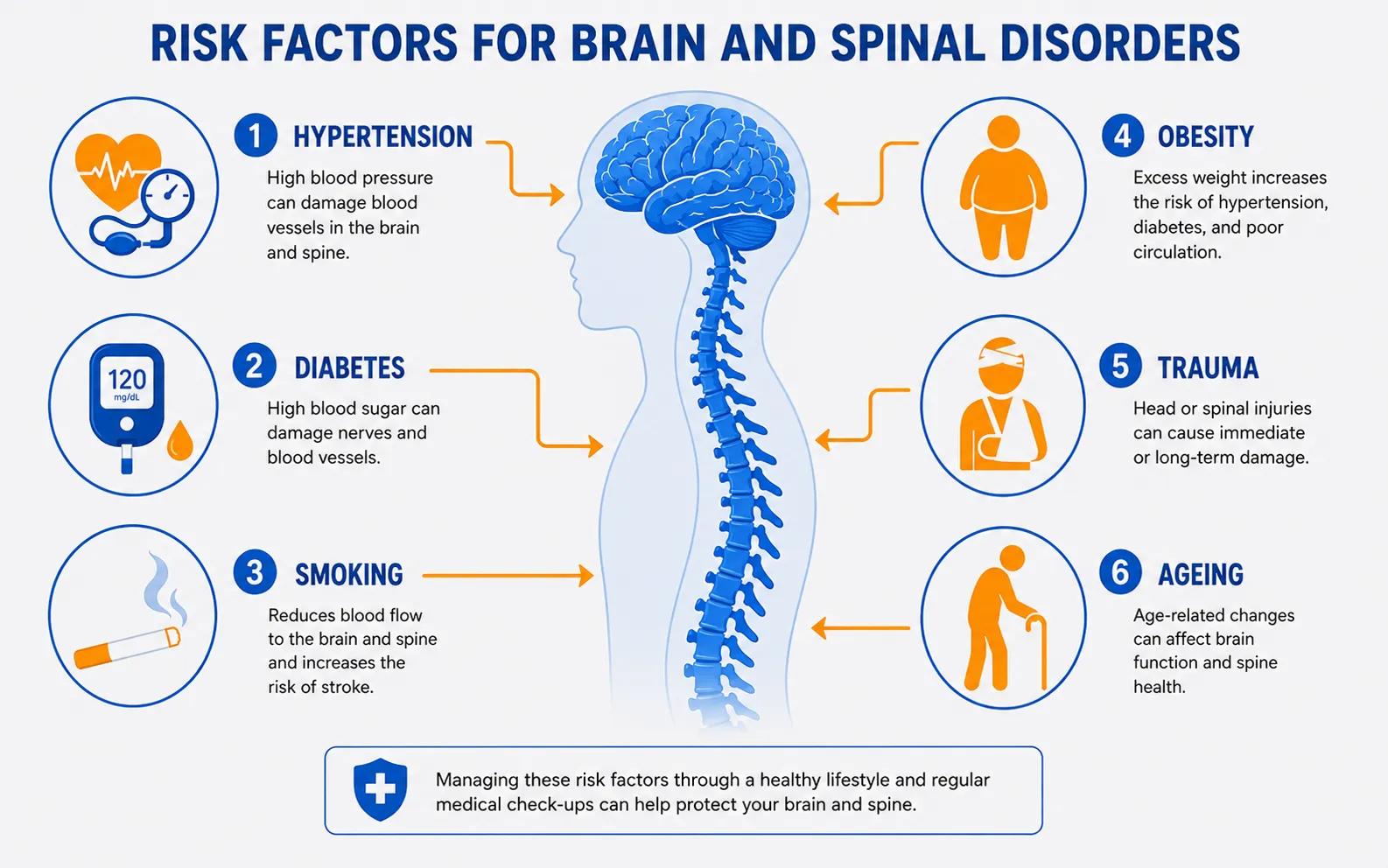
Understanding your personal risk profile helps in prevention and early detection. The most significant modifiable and non-modifiable risk factors include:
| Risk Factor | Associated Conditions |
|---|---|
| Hypertension (uncontrolled) | Stroke, cerebral haemorrhage, vascular dementia |
| Diabetes mellitus | Peripheral neuropathy, stroke, disc disease |
| Smoking and tobacco use | Stroke, spinal disc degeneration, brain tumours |
| Sedentary lifestyle / obesity | Lumbar disc disease, spinal stenosis, stroke |
| Age (above 50) | Degenerative spine disease, Parkinson's, dementia |
| Family history / genetics | Epilepsy, certain brain tumours, ALS |
| Occupational hazards (heavy lifting, vibration) | Lumbar disc herniation, cervical spondylosis |
| Prior head or spine trauma | Post-traumatic epilepsy, chronic pain, myelopathy |
Patients with multiple risk factors benefit from periodic neurological screening. The internal medicine specialists at Apex Hospitals can coordinate preventive assessments and refer appropriately to neurology or neurosurgery when needed.
Accurate diagnosis is the foundation of effective treatment. Modern neuroscience relies on a combination of clinical examination and advanced imaging:
MRI (Magnetic Resonance Imaging): The gold standard for soft-tissue visualisation of the brain and spinal cord — identifies tumours, disc herniations, demyelinating lesions, and vascular malformations.
CT Scan: Rapid assessment of haemorrhage, fractures, and bony anatomy — essential in emergency settings.
Electroencephalogram (EEG): Records electrical activity in the brain; indispensable for epilepsy diagnosis and classification.
Nerve Conduction Studies (NCS) and Electromyography (EMG): Assess peripheral nerve and muscle function to differentiate spinal cord from nerve root or peripheral nerve pathology.
Lumbar Puncture (Spinal Tap): Analysis of cerebrospinal fluid for infections, inflammatory conditions, and certain tumour markers.
PET-CT Scan: Used in neuro-oncology for tumour staging and detecting metastatic disease.
Apex Hospitals' on-site CT, MRI, and emergency laboratory infrastructure — available 24×7 — ensures that diagnostic workup begins without delay, which is particularly critical in stroke and trauma cases.
Treatment depends on the specific diagnosis, severity, and the patient's overall health. The major categories of treatment include:
Many neurological conditions — epilepsy, Parkinson's disease, migraine, multiple sclerosis, and early-stage degenerative spine disease — are managed primarily with medications. Anticoagulants and antiplatelets reduce stroke recurrence risk. Anti-epileptic drugs control seizures in the majority of patients. Disease-modifying therapies are increasingly available for autoimmune neurological conditions.
Advances in endoscopic and microscopic techniques now allow surgeons to decompress nerve roots and stabilise the spine through very small incisions — reducing blood loss, hospital stay, and recovery time compared with open surgery. Procedures such as microdiscectomy, endoscopic foraminotomy, and minimally invasive lumbar fusion are routinely performed at experienced spine centres. Patients asking "is spine surgery safe in India?" can be reassured that outcomes at NABH-accredited centres with high surgical volumes are comparable to international benchmarks.
Surgical resection remains the cornerstone of treatment for most primary brain tumours. Modern neurosurgery employs neuro-navigation systems, intraoperative neuromonitoring, and advanced operating microscopes to maximise tumour removal while protecting eloquent brain areas responsible for speech, movement, and memory. Post-operative care may include radiotherapy and chemotherapy, coordinated through the oncology department at Apex Hospitals.
Mechanical thrombectomy — the catheter-based removal of a clot from a blocked brain artery — has revolutionised ischaemic stroke outcomes when performed within the treatment window. Cerebral aneurysms can be treated by surgical clipping or endovascular coiling. These procedures require a hybrid cath lab environment and a coordinated neurovascular team.
Recovery does not end in the operating theatre. Structured physiotherapy, occupational therapy, and speech therapy are essential components of neurological rehabilitation. The physiotherapy and rehabilitation team at Apex Hospitals designs individualised programmes to help patients regain function and independence after brain or spine surgery.
Not every spine problem requires surgery. Epidural steroid injections, nerve blocks, radiofrequency ablation, and spinal cord stimulation are effective options for patients with chronic radiculopathy or failed back surgery syndrome. The pain and intervention specialists at Apex Hospitals offer a full range of interventional pain procedures.
For patients in Rajasthan seeking the best neurosurgery hospital in Jaipur, Apex Hospitals offers a combination of surgical volume, specialist training, and technology that is rare outside major metropolitan centres.
2,550+ brain surgeries and 2,400+ spine surgeries performed — a volume that directly correlates with better outcomes in complex neurosurgical cases.
Neurosurgeons trained at PGIMER Chandigarh — one of India's most prestigious postgraduate medical institutions — with additional international exposure at Wooridul Hospital, South Korea, a globally recognised centre of excellence for spine surgery.
Dedicated Neuro ICU with round-the-clock intensivist cover and the HOPE Tele-ICU Command Centre connecting 18 partner sites across Rajasthan for remote specialist consultation.
Intraoperative neuro-navigation systems and advanced operating microscopes for precision brain and spine surgery.
Intraoperative neuromonitoring to reduce the risk of neurological complications during complex procedures.
NABH accreditation — India's benchmark for hospital quality and patient safety.
Empanelled under Ayushman Bharat and major insurance/TPA schemes, making specialist neurosurgical care financially accessible.
The neuroscience team works in close collaboration with the neurology department at Apex Hospitals to ensure seamless medical and surgical management under one roof.
The most common causes include vascular events (stroke, haemorrhage), degenerative disc disease, tumours, infections (meningitis, spinal TB), trauma from road accidents or falls, and neurodegenerative conditions such as Parkinson's disease. Lifestyle risk factors — hypertension, diabetes, smoking, and obesity — significantly increase the likelihood of both brain and spine disorders.
Key warning signs include persistent neck or back pain that radiates into the arms or legs, numbness or tingling, weakness in the limbs, difficulty walking, and — most urgently — loss of bladder or bowel control. If you experience any of these symptoms, consult a spine specialist promptly. An MRI is usually the first investigation ordered.
Treatment depends on tumour type, grade, and location. The standard approach for most primary brain tumours is surgical resection using neuro-navigation and intraoperative monitoring, followed by radiotherapy and/or chemotherapy as indicated. At high-volume centres like Apex Hospitals in Jaipur, the neurosurgery and oncology teams collaborate closely to deliver comprehensive, personalised treatment plans.
Yes — at NABH-accredited hospitals with experienced spine surgeons and adequate surgical volumes, outcomes for common spine procedures (microdiscectomy, spinal fusion, decompression) are comparable to international standards. The key factors are surgeon training and experience, availability of intraoperative monitoring, and quality of post-operative rehabilitation. Apex Hospitals' spine team, trained at PGIMER and Wooridul Hospital, South Korea, meets all these criteria.
Apex Hospitals, Malviya Nagar, Jaipur is among the leading centres for neurosurgery in Rajasthan, with over 2,550 brain surgeries and 2,400 spine surgeries performed, PGIMER-trained surgeons with international exposure, a dedicated Neuro ICU, and NABH accreditation. The hospital is empanelled under Ayushman Bharat, making specialist care accessible to a wide range of patients.
Many cases can be prevented or their progression slowed through lifestyle modification: controlling blood pressure and blood sugar, quitting smoking, maintaining a healthy weight, exercising regularly, and using seat belts and helmets. Regular health check-ups are especially important for individuals with a family history of neurological conditions or multiple cardiovascular risk factors.
The neurosurgery and neurology teams at Apex Hospitals, Jaipur are available for consultations — early evaluation can make a critical difference in outcomes.