
By Apex Hospitals, Jaipur 9th April, 2026 6 min read
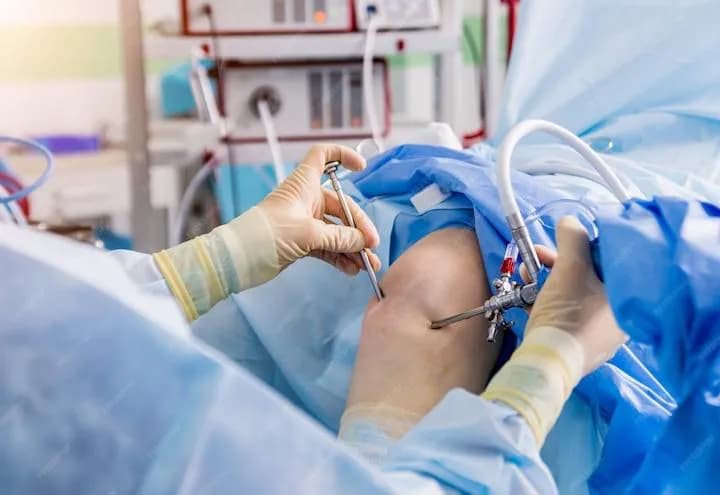
Arthroscopy is a surgical procedure that lets a doctor look inside a joint, and fix problems there, without making large cuts.
A tiny camera called an arthroscope is inserted through a small incision, about the size of a buttonhole. It transmits live images to a screen, giving the surgeon a clear, magnified view of everything inside the joint. If something needs to be repaired, additional small instruments are inserted through one or two more tiny incisions.
No large cuts. No long hospital stays. And for most patients, a much faster recovery than traditional open surgery.
Arthroscopy is used for the knee, shoulder, hip, ankle, wrist, and elbow. It can both diagnose joint problems and treat them, often in the same procedure.
| In simple terms: Arthroscopy is keyhole surgery for joints. The surgeon sees inside the joint through a tiny camera and repairs the problem through very small incisions, without opening the joint fully. |
Joints are complex structures. They contain cartilage, ligaments, tendons, and fluid-filled sacs, all of which can be damaged by injury, overuse, or age. Many of these problems are difficult to diagnose with imaging alone.
Arthroscopy allows surgeons to directly visualise the inside of a joint, confirm the diagnosis, and address the problem in real time, all through incisions smaller than a centimetre.
It is used both as a diagnostic tool, when imaging has not provided a clear answer, and as a treatment procedure for a wide range of joint conditions.
Arthroscopy can be performed on most major joints. The most commonly treated are:
• Knee — the most frequent site of arthroscopy. Used for meniscus tears, ACL injuries, cartilage damage, and knee osteoarthritis.
• Shoulder — used for rotator cuff tears, shoulder impingement, labral tears, frozen shoulder, and recurrent dislocations.
• Hip — used for labral tears, femoroacetabular impingement (FAI), and cartilage damage.
• Ankle — used for ligament injuries, osteochondral defects, and ankle impingement.
• Wrist — used for ligament tears, triangular fibrocartilage complex (TFCC) injuries, and wrist impingement.
• Elbow — used for tennis elbow, loose bodies inside the joint, and cartilage problems.
Here are some of the most common conditions for which arthroscopy is recommended:
• Meniscus tear — the torn cartilage cushion is repaired or trimmed
• ACL reconstruction — the torn ligament is replaced with a graft
• Cartilage damage — damaged cartilage is smoothed, repaired, or stimulated to regrow
• Loose bodies — fragments of bone or cartilage floating in the joint are removed
• Knee osteoarthritis — cleaning up the joint and removing debris can relieve pain in selected cases
• Rotator cuff tear — the torn tendon is reattached to the bone
• Shoulder impingement — bone spurs pressing on the rotator cuff are removed
• Labral tear — the ring of cartilage around the shoulder socket is repaired
• Frozen shoulder — tight, scarred tissue is released to restore movement
• Recurrent shoulder dislocation — the structures that stabilise the shoulder are tightened
• Labral tear — the cartilage rim around the hip socket is repaired
• Femoroacetabular impingement (FAI) — abnormal bone growth causing pain and reduced hip movement is corrected
• Cartilage damage inside the hip joint
• Ligament reconstruction — stretched or torn ankle ligaments are tightened or repaired
• Ankle impingement — bony or soft tissue overgrowth causing pain at the front or back of the ankle is removed
• Osteochondral defects — damage to the cartilage and bone surface of the ankle joint
| Open Surgery | Arthroscopy |
| Incision size | Large, 10–15 cm or more | 2–3 tiny cuts, each under 1 cm |
| Visualisation | Direct, limited field | Magnified camera view of entire joint |
| Hospital stay | 2–5 days or more | Often same day or overnight |
| Pain after surgery | Significant | Much less |
| Recovery time | Weeks to months | Days to weeks |
| Scarring | Visible scar | Minimal, almost invisible |
| Infection risk | Higher | Lower |
| Return to activity | Longer | Faster |
The procedure is straightforward. Here is a simple overview:
• You will be given anaesthesia — either general (you are asleep), regional (the area is numbed), or local depending on the joint and the procedure.
• Two or three tiny incisions are made around the joint — each less than 1 cm.
• The arthroscope — a thin tube with a camera and light source at the tip — is inserted into one incision. The joint is filled with sterile fluid to expand the space and improve visibility.
• The surgeon examines the inside of the joint on a screen, looking for damage or abnormalities.
• If a problem is found and can be treated, small surgical instruments are inserted through the additional incisions. The surgeon repairs, removes, or reconstructs the damaged tissue while watching on screen.
• The instruments are removed, the fluid is drained, and the tiny incisions are closed with one or two stitches or surgical tape.
Most arthroscopic procedures take between 30 minutes and 2 hours, depending on the complexity of the problem being treated.
| Same-day surgery: Many arthroscopic procedures are performed as day surgery, meaning the patient arrives in the morning, has the procedure, and goes home the same day. This is one of the biggest advantages over open surgery. |
Recovery depends on which joint was treated and what was done. Here is a general guide:
Joint & Procedure | Return to Light Activity | Return to Sport/Full Activity |
| Knee meniscus repair | 1–2 weeks | 3–6 months |
| Knee ACL reconstruction | 2–4 weeks | 9–12 months |
| Shoulder rotator cuff repair | 2–4 weeks | 4–6 months |
| Shoulder impingement | 1–2 weeks | 2–3 months |
| Hip labral repair | 2–4 weeks | 3–6 months |
| Ankle ligament repair | 1–2 weeks | 2–4 months |
Physiotherapy is an essential part of recovery after arthroscopy, regardless of which joint is treated. A structured rehabilitation program helps restore strength, flexibility, and full function.
| Most patients say: The recovery was significantly easier than they expected. Pain was manageable and they were back to daily activities far sooner than after previous open joint surgeries. |
Arthroscopy may be recommended when:
• Joint pain has not improved with physiotherapy, rest, and medication
• Imaging (MRI or X-ray) suggests damage to cartilage, ligaments, or tendons that may need surgical treatment
• The diagnosis is unclear despite imaging and clinical examination
• A sports injury has caused significant damage to the knee, shoulder, or another joint
• There is locking, catching, or instability in a joint that affects daily life or sport
Not all joint problems require arthroscopy. Your orthopaedic surgeon will assess your specific condition and recommend the most appropriate treatment — which may include physiotherapy, injections, or surgery.
Consult an orthopaedic surgeon if you experience:
• Persistent joint pain that has not improved with rest and physiotherapy
• Swelling or stiffness in a joint that limits daily activities
• A joint that locks, catches, or gives way
• A sports injury involving the knee, shoulder, or ankle
• Reduced range of movement in a joint
Early evaluation leads to accurate diagnosis and the right treatment — and in many cases, avoids the need for more extensive surgery later.
At Apex Hospitals, the Department of Orthopaedics, Joint Replacement & Sports Injury offers comprehensive arthroscopic surgery for all major joints. From sports injury management to complex joint reconstructions, the team combines surgical expertise with advanced technology to deliver precise, minimally invasive care.
Dealing with persistent joint pain?
Get an expert orthopaedic evaluation at Apex Hospitals.
Book a Consultation
Arthroscopy causes significantly less pain than open surgery. After the procedure, the joint may feel sore and swollen for a few days. Most patients manage this well with oral pain medication and ice packs.
Many arthroscopic procedures are performed as day surgery — patients go home the same day. More complex procedures, such as ACL reconstruction or rotator cuff repair, may require an overnight stay. Your surgeon will advise you beforehand.
Yes — for most procedures. Physiotherapy is an essential part of recovery and helps restore the strength and movement of the joint. The duration and intensity of physiotherapy depends on what was done during surgery.
Yes. Arthroscopy is well tolerated by patients of all ages. In older patients, it is often preferred over open surgery because of the smaller incisions and faster recovery.
Arthroscopy is generally very safe. Risks include infection, bleeding, blood clots, nerve or vessel injury, and stiffness — but these are uncommon. Your surgeon will discuss the specific risks relevant to your procedure before you consent.
Yes. The Department of Orthopaedics & Sports Injury at Apex Hospitals, Jaipur offers arthroscopic surgery for the knee, shoulder, hip, and ankle. The team has extensive experience in both diagnostic and therapeutic arthroscopy for sports injuries, degenerative joint conditions, and complex reconstructions.

Download Our App


Powered By Docfyn