By Apex Hospitals, March 24, 2026 6 min read
27 Lakh Estimated TB cases in India in 2024 — the highest in the world |
Source: WHO Global TB Report 2025 | Ministry of Health & Family Welfare, Government of India
India accounts for more TB cases than any other country on the planet. Yet every day, thousands of people dismiss a persistent cough as dust, pollution, or a seasonal cold, and delay getting tested for weeks or months.
That delay can be costly. Tuberculosis is one of the most treatable infectious diseases when caught early. But when left undiagnosed, it can spread to others, worsen significantly, and in some cases become life-threatening.
If you or someone you know has had a cough that simply will not go away, this article is for you. It explains what TB is, how to recognize it, when to get tested, and what treatment involves.
World TB Day: Every year on March 24, World TB Day is observed globally to raise awareness about the devastating health, social, and economic consequences of tuberculosis and to step up efforts to end the epidemic. |
Tuberculosis is a bacterial infection caused by Mycobacterium tuberculosis. It most commonly affects the lungs, but it can also affect other parts of the body including the spine, brain, kidneys, and lymph nodes.
TB spreads through the air. When a person with active TB coughs, sneezes, or even speaks, tiny droplets carrying the bacteria are released. Someone nearby can inhale these droplets and become infected.
Importantly, not everyone who is infected with TB bacteria becomes sick. The immune system often contains the bacteria without the person developing symptoms. This is called latent TB. But if the immune system weakens, due to conditions like diabetes, HIV, malnutrition, or stress, the latent infection can become active.
Key fact: TB is not spread by sharing utensils, touching someone, or shaking hands. It spreads only through the air when an infected person coughs or sneezes in an enclosed space. |
A persistent cough is the most well-known symptom of TB, but it is far from the only one. Many patients have several symptoms together, while others may only notice one or two.
• A cough that lasts more than 2–3 weeks, often with mucus or phlegm
• Coughing up blood or blood-streaked sputum
• Chest pain, especially when breathing or coughing
• Unexplained weight loss over weeks or months
• Persistent fatigue and weakness
• Fever, especially low-grade fever that comes and goes
• Night sweats, waking up drenched even in cool temperatures
• Loss of appetite
| The 2-week rule: A cough lasting more than 2 weeks should always be evaluated by a doctor. It does not always mean TB, but it always deserves a proper check-up. |
• Back pain or spine stiffness (TB of the spine)
• Swollen lymph nodes in the neck or armpits
• Headache, confusion, or stiff neck (TB of the brain)
• Blood in the urine or frequent urination (TB of the kidney)
These forms of TB, called extrapulmonary TB, are less common but more difficult to diagnose because the symptoms can look like other conditions entirely.
While anyone can get TB, some people face a higher risk than others. Understanding this can help with earlier diagnosis.
• People with diabetes — high blood sugar weakens the immune system's ability to fight TB bacteria
• Elderly individuals — immune function naturally declines with age
• People living with HIV or other conditions that suppress immunity
• Those who are malnourished or underweight
• People who live or work in crowded conditions — prisons, dormitories, shelters
• Healthcare workers with regular exposure to TB patients
• Those who have been in close contact with a confirmed TB patient
• Smokers — smoking damages the lung’s natural defenses
| TB and Diabetes: Diabetic patients are 2–3 times more likely to develop active TB than those without diabetes. If you have diabetes and a persistent cough, get tested for TB without delay. |
The good news is that TB is diagnosable through straightforward tests. If you have had a cough for more than two weeks or are experiencing other symptoms, here is what a doctor may recommend:
• Sputum test (CBNAAT / Gene Xpert) — the most common first-line test, where a sample of mucus is tested for TB bacteria. This test also detects drug-resistant TB.
• Chest X-ray — helps identify changes in the lungs that suggest TB infection
• Tuberculin Skin Test (TST / Mantoux test) — checks for immune response to TB bacteria
• IGRA blood test — a more precise blood test to detect TB infection
• CT scan or MRI — used when extrapulmonary TB (spine, brain, kidneys) is suspected
• Biopsy — for swollen lymph nodes or suspected TB in tissues
Early and accurate diagnosis is everything. The sooner TB is confirmed; the sooner treatment can begin — and the lower the risk of spreading it to family members.
This is one of the most commonly misunderstood aspects of tuberculosis. Not all TB infections are the same.
• Latent TB: The bacteria are present in the body but inactive. The person has no symptoms and cannot spread TB to others. However, latent TB can become active if the immune system weakens.
• Active TB: The bacteria are multiplying and causing symptoms. The person is unwell and can spread TB to others through the air.
| Important: Latent TB can be treated with preventive medication to stop it from becoming active. If you have been in contact with a TB patient, ask your doctor about getting tested. |
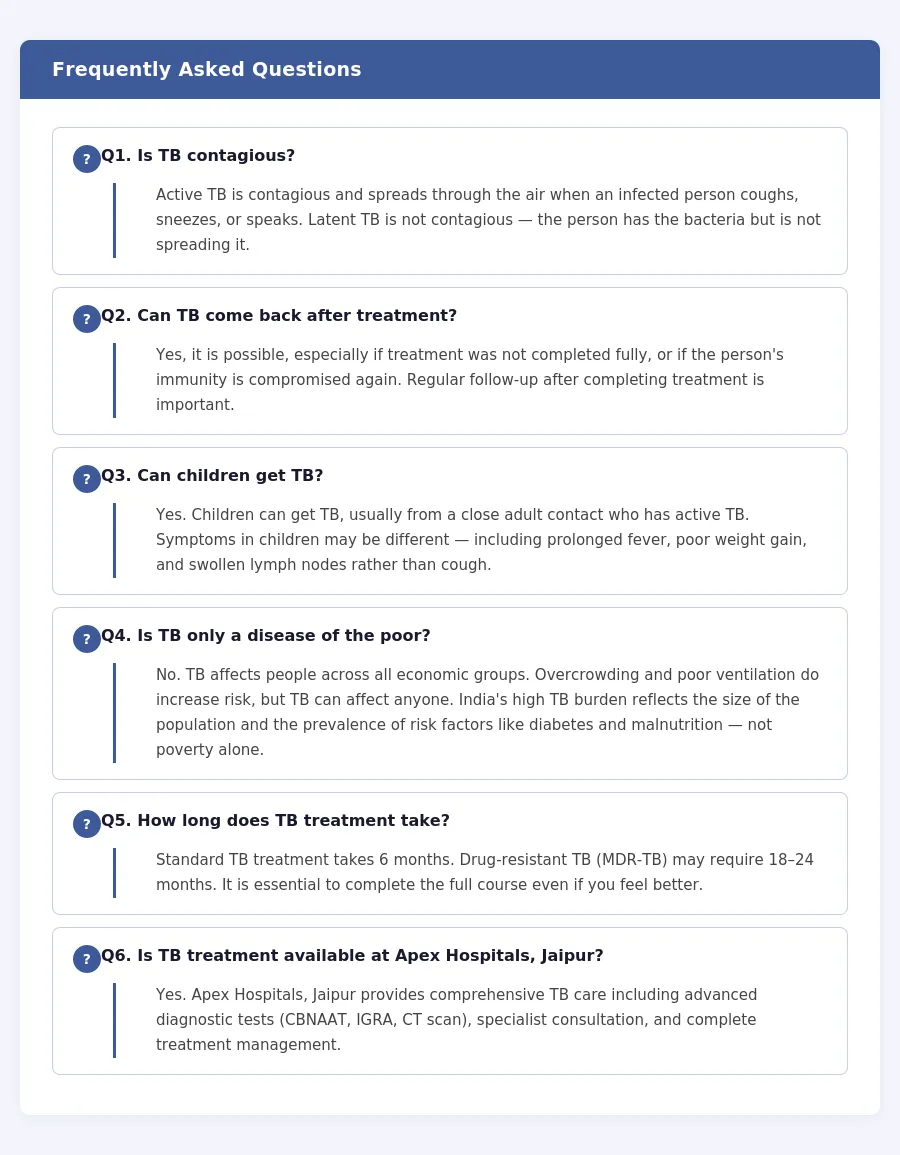
Tuberculosis is completely curable with the right treatment. The standard treatment involves a combination of antibiotics taken over 6 months. It sounds long — but every day of that course matters.
• Months 1–2 (Intensive Phase): Four antibiotics are taken together every day. This is the most important phase — it kills the majority of bacteria quickly.
• Months 3–6 (Continuation Phase): Two antibiotics are continued to eliminate any remaining bacteria and prevent relapse.
The most critical rule in TB treatment is this: do not stop medicine early, even if you feel better. Stopping treatment midway is one of the leading causes of drug-resistant TB, a far more dangerous form that is harder and more expensive to treat.
| Drug-Resistant TB (MDR-TB): When TB bacteria survive despite standard antibiotics, usually because treatment was incomplete, they become resistant. MDR-TB requires 18–24 months of treatment with stronger, more expensive drugs. Completing your full course of treatment is the single most important thing you can do. |
Yes, to a significant extent. Here is what helps:
• BCG vaccination — given to newborns in India, it protects against severe forms of TB in children
• Early diagnosis and treatment — treating active TB cases quickly prevents spread to others
• Good ventilation — open windows and airflow reduce the concentration of TB bacteria indoors
• Wearing a mask — if you are in contact with a known TB patient, a mask reduces transmission risk
• Managing underlying conditions — keeping diabetes, HIV, and other conditions under control reduces TB risk
• Completing treatment — prevents the development of drug-resistant TB
Do not wait. See a doctor if you or a family member has any of the following:
• A cough that has lasted more than 2 weeks
• Blood in the cough or sputum
• Unexplained weight loss
• Night sweats that soak your clothes
• Persistent low-grade fever
• Chest pain when breathing or coughing
• You have been in close contact with someone diagnosed with TB
TB is not something to self-diagnose or self-medicate. A proper test takes minutes and can give you clarity immediately. The earlier it is caught, the simpler the treatment.
At Apex Hospitals, Jaipur, patients with persistent cough, respiratory symptoms, and suspected TB receive prompt evaluation by experienced specialists. The hospital is equipped with advanced diagnostic facilities including CBNAAT testing, chest imaging, and pulmonary function tests to ensure accurate and timely diagnosis.
Early detection. Complete treatment. Better outcomes.
Has your cough lasted more than 2 weeks?
Don’t ignore it. Get evaluated today.
Book a Consultation
Medically Reviewed by:
Dr. Mehul Agarwal
Consultant - Pulmonology
MBBS, DNB (respiratory diseases), FCCS